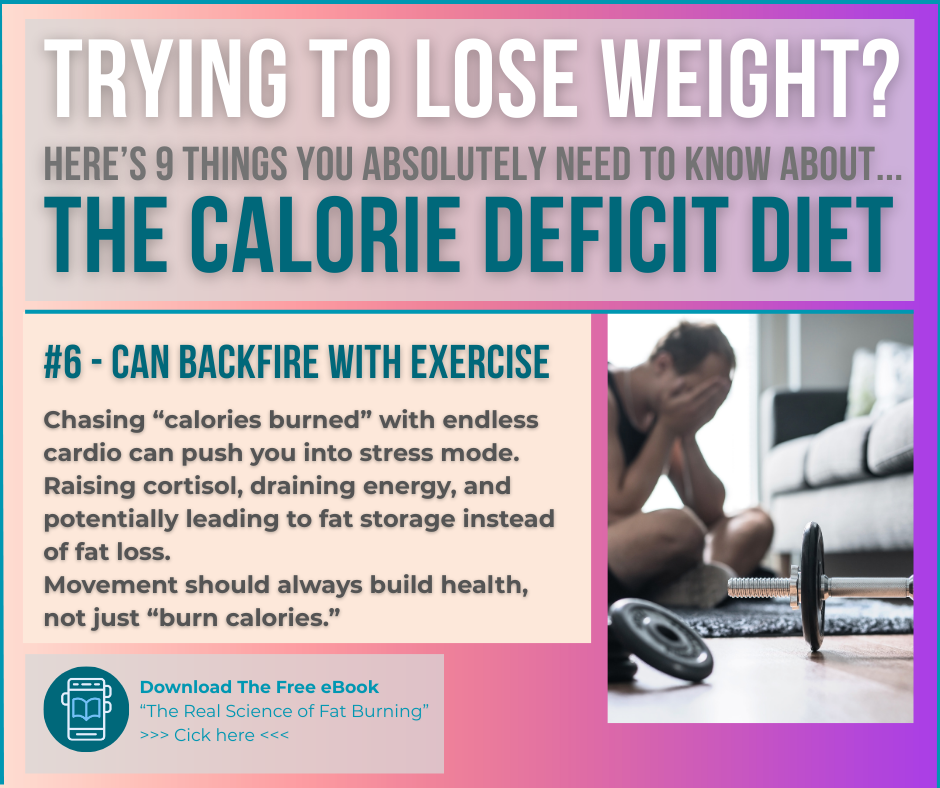
Problem #6 — The Calorie Deficit Diet Can Backfire With Exercise
Many people try to burn more calories by increasing exercise.
It feels logical, yet the body does not always respond the way you expect. In some cases, more exercise pushes the system further from fat loss, not closer.
Learn more below...
What This Means
Exercise is valuable for health, strength, mobility, and mental wellbeing. However, when it is used only to “burn calories,” it becomes unpredictable. Stress, sleep, hormones, and energy levels determine how your body reacts to training.
If the system is already under pressure, the extra demand can work against you.
Why This Makes Weight Loss Harder
When your body feels stressed or under-fuelled, high-intensity or long-duration exercise increases cortisol. This can reduce fat burning, raise cravings, and lower energy later in the day. You may feel hungrier, more tired, and less motivated, even though you exercised more.
This creates confusion and often leads to a cycle of “work harder, feel worse, eat more.”
What’s Actually Going On in the Body
1. Increased cortisol reduces fat burning
Cortisol rises during intense or prolonged exercise, especially when energy is low. This shifts the system towards conserving energy and increases cravings for fast fuel.
2. Hunger rises after hard sessions
The body tries to replace energy quickly. This leads to increased appetite and stronger cravings, particularly for high-calorie foods in the evening.
3. NEAT decreases when you feel tired
After intense workouts, daily movement can drop without you noticing. Steps fall. Posture slumps. You move less overall. This reduction can offset much of what was “burned” during the workout.
4. Recovery demands shift energy use
When the system is under-recovered, more energy is diverted to repairing muscle and tissue. This can make fatigue feel worse and affect motivation.
5. Hormones influence training response
Poor sleep, menstrual cycle shifts, stress, or under-eating all change how your body responds to exercise. Two identical sessions can produce very different results depending on your physiological state.
What This Means for You
If exercise has ever made you hungrier, more tired, or more stressed, it makes sense. You were following advice that did not match your system’s capacity.
When you train in a way that supports energy, recovery, and hormonal balance, the process feels easier and more predictable.
⭐ There Is a Better Way – Understand the Real Science of Fat Burning
Fat burning depends on energy rhythm, hormones, recovery, and daily movement, not just calorie burn. My free guide explains how to work with your system instead of pushing it into stress mode.
Download Your Free Copy of The Real Science Of Fat BurningExplore the Next Calorie Deficit Problem - It Overlooks Food Quality
The next issue explains why food quality matters far more than calories alone and how different foods influence hormones, fullness, and fat burning.
Continue to #7- Calorie Deficit Overlooks Food QualityThere Is a Better Way
Understand the Real Science of Fat Burning
Download Your Free Copy Now
Most people are told to focus on eating less and moving more. It is familiar advice, yet it often leaves you stuck, hungry, and unsure why your body is not responding. When you understand how fat burning actually works, the process becomes clearer and far more achievable.
Fat burning is a metabolic state. It depends on your hormones, your energy rhythm, and the way your body chooses fuel throughout the day. Once these systems line up, weight loss stops feeling like a fight and starts behaving predictably.
I have put the key principles into a short guide. It explains the science in plain English and shows you the steps that help your system shift towards natural, steady fat loss.
You can download your copy below and start understanding what has been missing from the calorie-deficit approach.
Download Your Copy of the Science of Fat Burning
Start Your Weight Loss Project Properly
Lose Weight Naturally or Your Money Back
When you understand how your body works, change becomes predictable. The course takes you through the science of fat burning, the psychology of consistency, and the daily structure that helps your system stay steady.
It is designed for real life. No extremes. No pressure. Just a clear method that respects your biology and your bandwidth.
If you complete the course and do not feel different, you get your money back.
You can join now and begin at your own pace.
Explore the full programme here.
learn More About Lose Weight Naturally or Your Money Back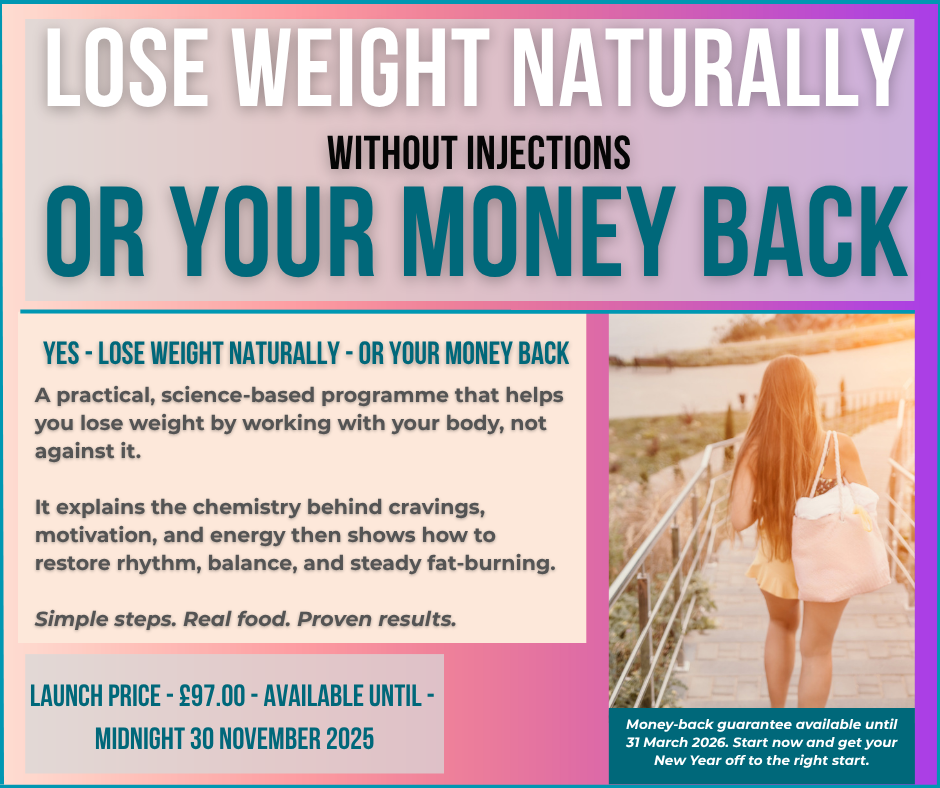
We Need To Talk About Weight Loss
For more than a century, people have been told that weight loss is simple. Eat less. Move more. Create a deficit.
If only it worked that way.
This is why so many people follow the deficit rules and still feel stuck, confused, or unable to keep the weight off. It is not a lack of effort. It is a model that leaves out the mechanisms that matter.
I have broken this down into nine clear problems.
Each one explains a part of the puzzle and helps you understand what has been happening inside your system.
You can explore each of the 9 problems below. Each page gives a simple explanation, grounded in physiology and psychology, so you can make sense of your own experience.
1. It Oversimplifies Weight Loss
The idea sounds simple, yet real bodies are more complex. Stress, sleep, hormones, and appetite signals all shape how energy is used. This page explains why the maths never told the whole story.
Learn More2. It Ignores Hormones
Your appetite, cravings, and fat storage are regulated by chemical messengers. A deficit does not control them. This section shows how these signals influence your results.
Learn More3. It’s Hard to Measure
Food labels, calorie trackers, and metabolism estimates are often inaccurate. This creates confusion and frustration. Here you can see why the numbers shift from day to day.
Learn More4. It Misses Metabolic Adaptation
When you cut calories, your body adjusts. Energy drops. Hunger rises. Progress slows. This page explains how your system protects itself and why dieting becomes harder over time.
Learn More5. It Doesn’t Explain Why You’re Hungry
Constant hunger is not a lack of discipline. It is a physiological response. This section explores why cravings, fatigue, and emotional bandwidth affect what and when you eat.
Learn More6. It Can Backfire With Exercise
Chasing calorie burn can push your system into stress mode. Cortisol rises and energy falls. This page shows why certain types of exercise can work against you.
Learn More7. It Overlooks Food Quality
Two foods with the same calories can have completely different effects on fullness, hormones, and digestion. This section explains why quality shapes outcomes more than quantity.
Learn More8. It Fuels Guilt and Shame
When progress is reduced to numbers, people blame themselves when it does not work. This page explains how guilt, pressure, and “starting again” loops develop.
Learn More9. It’s Not the Whole Story
Calories matter, but they are only part of a much larger system. This section shows how psychology, physiology, and lifestyle combine, and how the Mind Works approach connects them.
Learn MoreWays to Work With Me
There’s no single right way to begin. Some people want immediate relief. Others want deeper personal work. Some prefer to learn at their own pace.
The options below are designed to meet you where you are now not where you think you should be.
If you’re unsure which path is right for you, starting with a Reset Session is usually the simplest option.

🔄Reset Sessions
If you feel stuck, overwhelmed, or at a crossroads, a Reset Session offers a focused pause and a way forward.
In 90 minutes, we work to settle your system, make sense of what’s happening, and create a clear, practical next step.
This is often the best place to start if things feel urgent or tangled.

🧩 1:1 Hypnotherapy
For deeper, ongoing therapeutic work.
These sessions help you explore patterns, beliefs and emotional responses, using hypnotherapy and psychological tools to support lasting change.
This is a good fit if you want space to work through things gradually and properly.

📚 Online Courses
If you prefer to work independently, the courses offer structured, self-paced learning using the same frameworks I teach in sessions.
You’ll gain understanding, tools and clarity, with the flexibility to move at your own speed.