A — Anxiety: A Nervous System Perspective | The A–Z of Stress & Anxiety
Feb 17, 2026Introduction
This piece sits at the beginning of The A–Z of Stress & Anxiety for a reason.
Anxiety is often the first word people reach for when something does not feel right internally. It is the label most readily available in everyday language, and the one most commonly typed into a search bar. That does not mean it is simple, uniform, or even particularly well understood.
Across this project, stress and anxiety are approached not as problems to be eliminated, but as signals. They reflect the state of an internal system, particularly the nervous system, responding to load, pressure, uncertainty, or threat. Each letter in the A–Z names a different entry point into that experience. Anxiety is one of the most common doors people walk through.
Within the Mind Works framework, anxiety is often understood in relation to nervous system pressure. When the demands placed upon the system exceed its ability to regulate and recover, internal strain increases. As this pressure rises, the brain’s conscious capacity and control can begin to reduce. Attention narrows, thinking becomes less flexible, and the system shifts toward protection rather than exploration.
What follows is not an attempt to define anxiety neatly, or to resolve it quickly. It is an attempt to describe it accurately enough that it can be recognised, oriented to, and understood in context.
What Anxiety Often Looks Like in Real Life
In clinical work and everyday conversation, anxiety rarely presents as a single, clear sensation. It is more often a cluster of experiences that shift over time.
Cognitively, it may show up as persistent mental activity that does not settle. Thoughts loop, scan, rehearse, or anticipate. Attention is drawn toward what could go wrong, what has not yet been resolved, or what feels uncertain. Even when nothing specific appears to be wrong, the mind may struggle to rest.
When nervous system pressure is elevated, conscious capacity and control often reduce. This means the brain has less available bandwidth for perspective, reasoning, and balanced decision-making. Thinking can become repetitive, urgent, or narrowed around potential problems.
Emotionally, anxiety is not always fear in the dramatic sense. It can be subtle and ambient. A sense of unease. Irritability without a clear cause. A feeling of being on edge, or unable to fully relax into the present moment.
Physically, people often describe tension before they describe worry. Tightness in the chest or jaw. Shallow breathing. A restless body that cannot quite settle. Sleep that looks intact on paper but does not feel restorative. Energy that spikes and crashes rather than flowing steadily.
These physical shifts are not random. They reflect a nervous system that is carrying pressure and preparing the body to respond.
Behaviourally, anxiety can pull in opposite directions. Some people become busy, vigilant, and over-responsible. Others withdraw, avoid, or procrastinate, not out of laziness but because engagement itself feels demanding. Both responses are attempts to manage internal strain.
Relationally, anxiety can narrow the field. Conversations feel harder. Decisions feel weightier. The capacity to tolerate disagreement or ambiguity reduces. People may appear distant or preoccupied, even when they care deeply.
None of these experiences are pathological in themselves. They are expressions of a system working hard to maintain safety and control under conditions it perceives as demanding.
What Is Often Misunderstood About Anxiety
One of the most persistent misunderstandings about anxiety is that it is primarily a problem of thinking. From this position, the solution appears obvious. Change the thoughts. Reassure yourself. Be more rational. Try harder to relax.
This assumption is understandable. Anxiety does involve the mind. But it is not generated by logic alone, and it is rarely resolved by logic in isolation.
Another common misunderstanding is that anxiety reflects weakness, fragility, or a lack of resilience. In practice, I often see the opposite. Anxiety frequently develops in people who are conscientious, responsible, and capable. It emerges not because they care too little, but because they care deeply while carrying sustained pressure.
There is also a tendency to treat anxiety as an enemy to be defeated. This framing can unintentionally increase internal strain. The system is already activated, and now it is also being criticised for being activated.
What is often missed is that anxiety makes sense when viewed in context. It is not a random malfunction. It is a response to load, pressure, and perceived threat, shaped by history, environment, and current demands.
What Is Happening Underneath
At a physiological level, anxiety reflects a nervous system oriented toward detection and protection. The body shifts into a state of readiness. Attention narrows. Energy is mobilised. The system prepares to respond.
Within the Mind Works model, this is described as increasing nervous system pressure.
Pressure does not necessarily arise from a single dramatic event. More often it develops gradually through accumulated demands. Financial concerns, responsibility for others, work stress, health challenges, uncertainty about the future, or unresolved emotional experiences can all contribute to the overall strain placed on the system.
The nervous system does not distinguish neatly between physical threat and psychological demand. It responds to the overall pattern of pressure.
As this pressure rises, the brain begins to prioritise protection. One consequence of this is a reduction in conscious capacity and control. Thinking becomes more reactive. Perspective narrows. The ability to weigh multiple possibilities or tolerate uncertainty reduces.
Stress chemistry also plays a role. When activation becomes sustained, recovery becomes harder. Sleep may become lighter. Blood sugar regulation may become less stable. Energy can fluctuate. These physiological shifts feed back into mood, concentration, and tolerance.
Psychologically, anxiety often reflects a loss of internal safety. When the system does not feel settled, the mind attempts to regain control through planning, analysing, rehearsing, and scanning for potential problems. This is not a flaw. It is a protective strategy.
Over time these patterns can reinforce each other. Increased pressure narrows attention. Narrowed attention increases mental load. Mental load increases exhaustion. Exhaustion further reduces capacity.
Understanding this does not remove anxiety immediately. But it changes how the experience is interpreted. Anxiety becomes information rather than a verdict.
How This Fits Within the Mind Works Framework
Within the Mind Works approach, anxiety is rarely viewed in isolation. It sits within a broader pattern of system functioning.
In terms of the Process of Change, anxiety often appears early. It is one of the ways the system signals that something is no longer sustainable. Before insight and before action, there is often unease.
Within the Tower Block model, anxiety commonly corresponds to mid-level instability. The individual is still functioning, still coping, but with increasing effort. The foundations are under strain, even if this is not immediately visible from the outside.
From a Parts of Self perspective, anxiety can reflect tension between different internal roles. A part pushing for performance or responsibility. A part carrying emotional or physical load. A protective part attempting to manage the gap between them. Anxiety is the friction generated at these interfaces.
Psychological processes of distress also come into play. Overthinking, hypervigilance, avoidance, and self-pressure are not separate problems. They are patterns that emerge when the system is stretched and conscious capacity begins to reduce.
Finally, the Pillars of Health provide important context. Anxiety rarely exists without impact on sleep, energy, physiology, or relationships. Equally, disruption in these areas can increase nervous system pressure and reinforce anxious patterns.
These frameworks are not explanations to memorise. They are ways of orienting to what is happening without reducing it to a single cause or a personal failing.
Orientation Rather Than Solutions
When anxiety is approached as something to be fixed, the response is often premature action. Techniques are applied before the system is understood. Effort increases before capacity is stabilised.
An orientation-based approach moves more slowly. It asks different questions.
What is the system responding to?
What pressure is currently present?
Where is capacity being depleted?
What patterns have developed over time?
This is not passivity. It is sequencing. Stabilisation precedes change. Understanding precedes effort.
In my own work, both personally and professionally, I have found that anxiety softens when the system begins to feel safer, not when it is argued with.
Safety here does not mean comfort at all costs. It means sufficient regulation for clarity and conscious control to return.
From that position, change becomes possible. Not forced, but supported.
Closing Reflection
Anxiety is not a personal defect. It is a state. It reflects how the nervous system is organised in response to lived conditions.
For some, simply recognising this can be relieving. The experience shifts from “something is wrong with me” to “something in my system needs attention.” That shift alone can reduce internal pressure.
For others, additional support focused on stabilisation and nervous system regulation may be appropriate. Not as a cure, but as a way of creating enough internal space for the system to reset and reorganise.
This is the orientation that underpins Reset-style support within the Mind Works approach. Not urgency. Not fixing. Just the right level of containment to allow the system to settle and find its footing again.
If This Feels Familiar, You Don’t Have To Figure It Out Alone
If parts of this article resonated with you, it may be a sign that your nervous system has been carrying more pressure than it was designed to handle.
Many people spend months or years trying to push through with willpower, productivity systems, supplements, or coping strategies, only to find themselves returning to the same patterns of stress, fatigue, procrastination, anxiety, or low motivation.
Sometimes it helps to step back and look at the bigger picture.
Stress Reset Session
In a 90-minute one-to-one Reset Session, we explore what is happening in your nervous system, your energy, and your thinking patterns.
Together we identify what is driving the cycle and what practical changes will begin to reduce the pressure and restore capacity.
You leave with a clearer understanding of what is happening and a set of realistic next steps tailored to you.
👉 Learn more about Reset Sessions
Free Resources
If you would prefer to explore these ideas in your own time, you can begin with the free resources below.
These explain the core ideas behind the Mind Works approach and how stress can influence energy, focus, motivation, anxiety, and even weight.
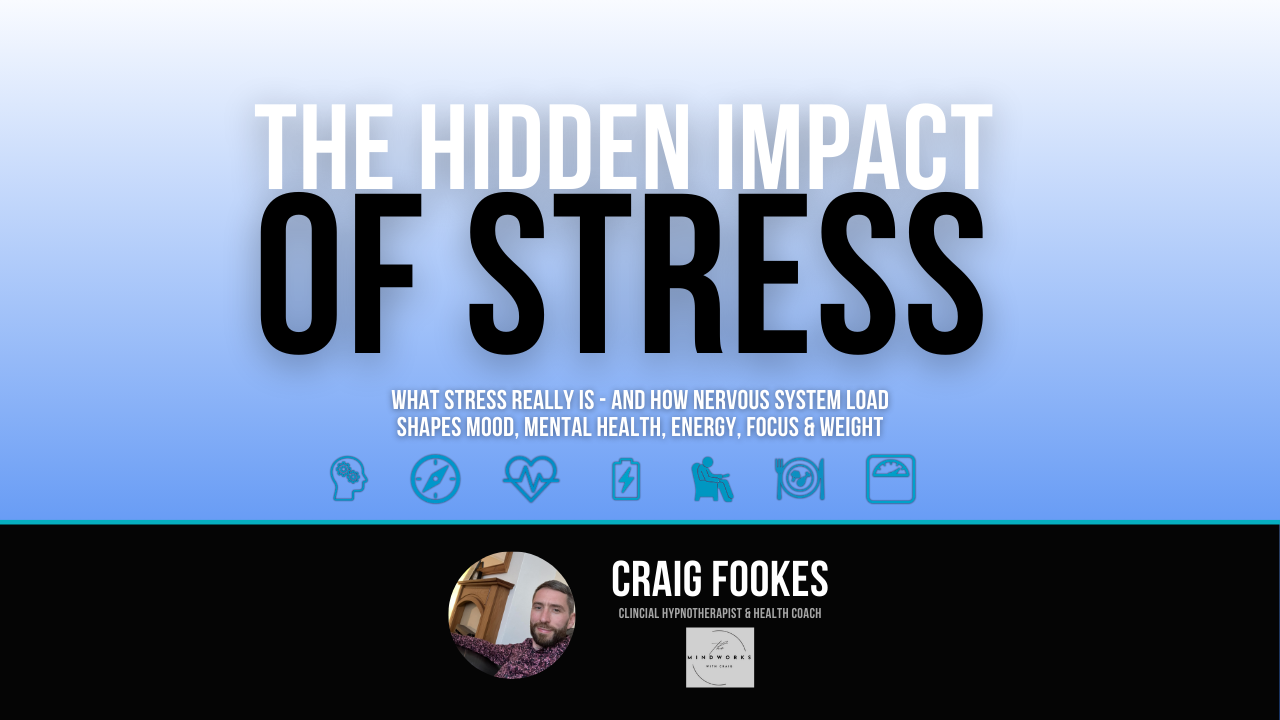
📘 The Hidden Impact of Stress
A short guide explaining what stress really is and how it affects the nervous system, thinking patterns, and daily behaviour.
📘 Stress, Cortisol and Weight
A short ebook exploring how stress hormones influence appetite, cravings, fat storage, and weight regulation.
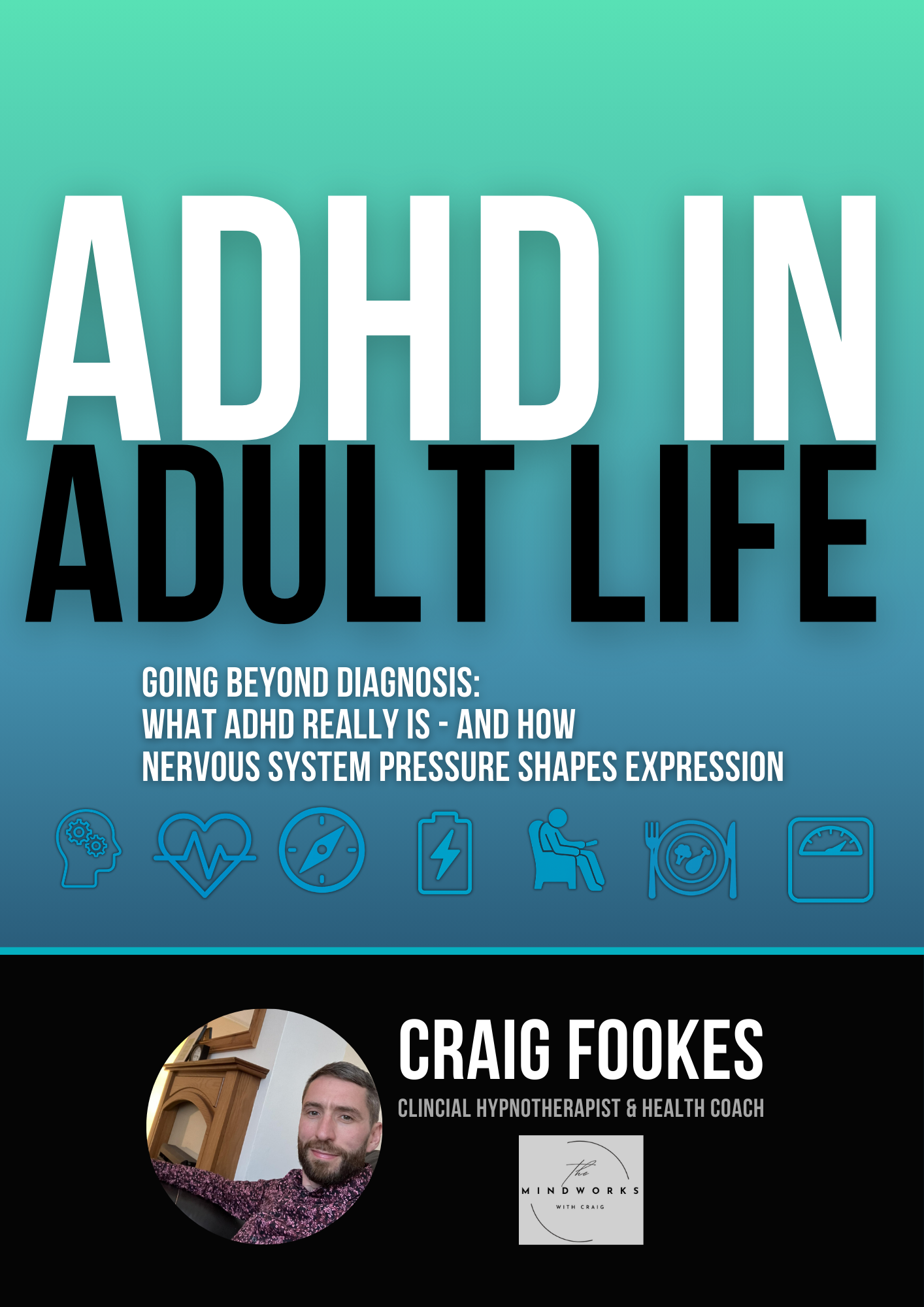
📘 ADHD in Adult Life
A practical guide exploring focus, motivation, procrastination, and how nervous system pressure can affect attention and regulation.
📘 Nervous System Reset Course (Waitlist) A structured course explaining how stress affects energy, focus, anxiety, and weight, and how to restore balance.
📖 Mind Works Blog
Explore articles on anxiety, burnout, nervous system health, and recovery.
Anxiety, Weight Gain, or Patterns That Feel Stuck?
Understand What May Be Driving Them
Many people approach anxiety and weight loss as separate problems.
In practice, both are often influenced by nervous system load.
When stress remains elevated, blood sugar stability shifts. Cravings increase. Fat burning becomes less efficient. Sleep lightens. Focus narrows. Emotional tolerance reduces.
At the same time, internal conflict intensifies. One "part of you" seeks progress. Another "part of you" seeks relief.
Over time, this can present as anxiety, weight gain, burnout, or more complex patterns that feel resistant to willpower alone.
Understanding how your nervous system is functioning is often the first step toward steadier change.
Stay connected with news and updates!
Join our mailing list to receive the latest news and updates from our team.
Don't worry, your information will not be shared.
We hate SPAM. We will never sell your information, for any reason.