Z — Zoned Out: A Nervous System Perspective | The A–Z of Stress & Anxiety
Feb 20, 2026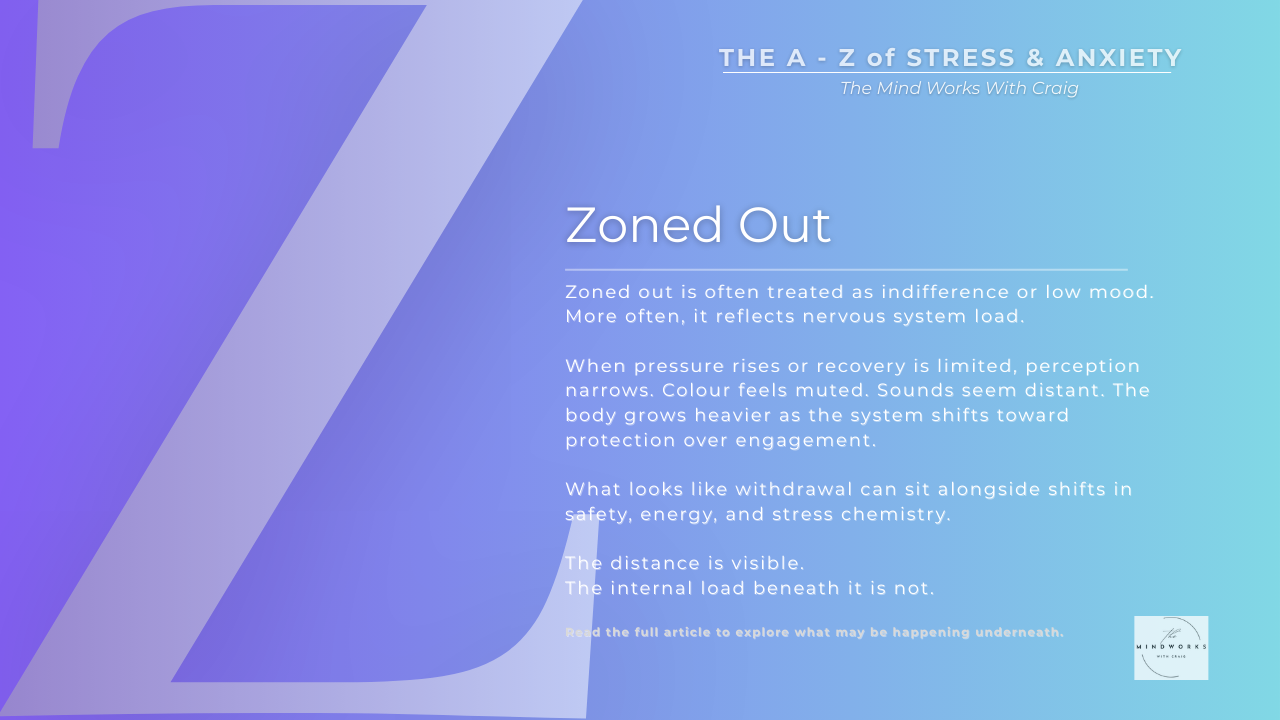
Z – Zoned Out
Introduction
Within The A–Z of Stress & Anxiety, each letter represents a different doorway into understanding how the nervous system expresses pressure. Some entries describe activation, tension, panic, or urgency. Others describe something quieter and more difficult to name.
Zoned out sits firmly in that second category.
It is not dramatic. It is not loud. It does not look like anxiety in the conventional sense. Yet it is one of the most common lived experiences under prolonged stress.
Rather than agitation, it brings distance. Rather than racing thoughts, it brings dullness. Rather than visible struggle, it brings absence.
Understanding this state requires recognising that stress does not only mobilise. It can also slow, mute, and shut down.
What Zoned Out Often Looks Like in Real Life
People often describe this state using surprisingly similar language.
It can feel as though life is being experienced through water. Sounds seem further away. Colours appear slightly drained. The body feels heavier, as if gravity has quietly been turned up. Movements are slower. Speech is flatter.
There may be a sense of watching events unfold rather than fully participating in them. Conversations are heard, but not fully absorbed. Tasks are completed, but without engagement or emotional colour.
Cognitively, concentration can feel foggy. Words may take longer to find. Decision-making becomes effortful. The mind may not be racing, but it is not sharp either.
Emotionally, the range narrows. Joy feels muted. Frustration feels distant. Even distress can feel oddly dulled.
Behaviourally, people may withdraw slightly. Not dramatically, but subtly. Social contact feels effortful. Emails go unanswered. Messages are read and not replied to. Plans are postponed.
Relationally, others may interpret this as disinterest or moodiness. In reality, it is often a system conserving energy.
In clinical work, this state is frequently described as disconnection. Not complete detachment from reality, but a step back from intensity. A turning down of volume.
It is important to note that this experience can be unsettling. Many people fear that something is fundamentally wrong when they notice the flattening of colour or emotional tone. The fear itself can add further stress.
What Is Often Misunderstood About This
The most common misunderstanding is that being zoned out means laziness, indifference, or a lack of effort.
Another assumption is that it represents depression in its most severe form. While low mood and shutdown can overlap, zoning out is often a stress response rather than a fixed identity or diagnosis.
There is also a belief that the solution is simply stimulation. Exercise more. Push harder. Engage socially. Stay busy.
At times, activity can help. At other times, pushing into a depleted system increases shutdown.
This is where logic and motivation alone often fail. If the nervous system has shifted into conservation mode, effort alone cannot restore clarity. The body does not respond to willpower in the way productivity culture suggests.
It can feel counterintuitive to consider that numbness and heaviness are still stress responses. Many assume stress must feel fast and anxious. In reality, the nervous system has multiple survival gears.
What Is Happening Underneath
From a physiological perspective, zoning out is often associated with parasympathetic dominance of a particular kind.
When stress is acute, the sympathetic branch mobilises. Heart rate rises. Muscles tense. Attention narrows. This is the familiar fight or flight state.
However, when stress is prolonged or overwhelming, the system can shift toward a shutdown response. This is not calm regulation. It is conservation.
In simplified terms, the nervous system determines that mobilisation is either too costly or unlikely to resolve the threat. The solution then becomes energy preservation.
This can alter perception. Sensory processing dampens slightly. Emotional intensity reduces. Cognitive sharpness softens.
Stress chemistry also plays a role. Chronic exposure to cortisol and adrenaline affects sleep, inflammation, and energy systems. Over time, the body adapts by reducing output. What feels like heaviness is often systemic fatigue.
Psychologically, zoning out can function as protection. When emotional load becomes too high, the mind narrows access to feeling. This is not weakness. It is adaptive patterning.
Importantly, this state is data. It signals that the overall load may have exceeded capacity.
How This Fits Within the Mind Works Framework
Within the Tower Block metaphor, zoning out often corresponds to a drop in level.
Higher levels represent clarity, flexibility, and energy. Mid-level instability may involve anxiety and overthinking. As levels fall further, the system may move toward disconnection and conservation.
In the Process of Change, this state frequently appears in the Recurring Cycle stage. People push, ignore early signals, override fatigue, and continue climbing. Eventually the system responds by reducing output.
The Parts of Self model also helps here. The Protective Self may withdraw energy in order to prevent further overload. The Current Self experiences heaviness and fog. The Ideal Self often reacts with frustration, creating internal conflict.
Psychological Processes of Distress can amplify this pattern. Underestimating stress and overestimating available energy leads to chronic mismatch. The system compensates by dampening.
The Pillars of Health are also relevant. Sleep disruption, nutritional instability, social strain, and unprocessed emotional experiences all accumulate. Zoning out rarely emerges in isolation. It tends to reflect combined pressure across pillars.
Orientation Rather Than Solutions
When people experience zoning out, the instinct is often to force change.
A more helpful first step is orientation.
Where is overall load currently sitting. How long has pressure been building. Which pillars are under strain.
Stabilisation precedes optimisation. Attempting to leap straight into productivity can deepen shutdown.
Recognition that this state is protective shifts the internal narrative. Instead of asking, “Why am I like this?” a more useful question becomes, “What has my system been carrying?”
This reframing does not deny responsibility. It restores context.
Clarity tends to return when capacity gradually increases. That process is rarely dramatic. It is usually steady and layered.
Closing Reflection
Feeling zoned out can be unsettling, particularly when colour, sound, and emotional tone feel slightly distant. Yet this experience is often the nervous system signalling that sustained activation has reached its limit.
Rather than evidence of failure, it can represent an intelligent adaptation to overload.
Where this state persists or interferes with daily life, support that focuses on nervous system stabilisation and capacity rebuilding can be appropriate. Structured Reset-style work often begins here, not by forcing momentum, but by restoring regulation.
Stress does not always shout. Sometimes it withdraws. Understanding that difference is part of building mental strength in a grounded and sustainable way.
Anxiety, Weight Gain, or Patterns That Feel Stuck?
Understand What May Be Driving Them
Many people approach anxiety and weight loss as separate problems.
In practice, both are often influenced by nervous system load.
When stress remains elevated, blood sugar stability shifts. Cravings increase. Fat burning becomes less efficient. Sleep lightens. Focus narrows. Emotional tolerance reduces.
At the same time, internal conflict intensifies. One "part of you" seeks progress. Another "part of you" seeks relief.
Over time, this can present as anxiety, weight gain, burnout, or more complex patterns that feel resistant to willpower alone.
Understanding how your nervous system is functioning is often the first step toward steadier change.
Stay connected with news and updates!
Join our mailing list to receive the latest news and updates from our team.
Don't worry, your information will not be shared.
We hate SPAM. We will never sell your information, for any reason.