The A–Z of Stress & Anxiety | A Nervous System Function–First Approach
Feb 24, 2026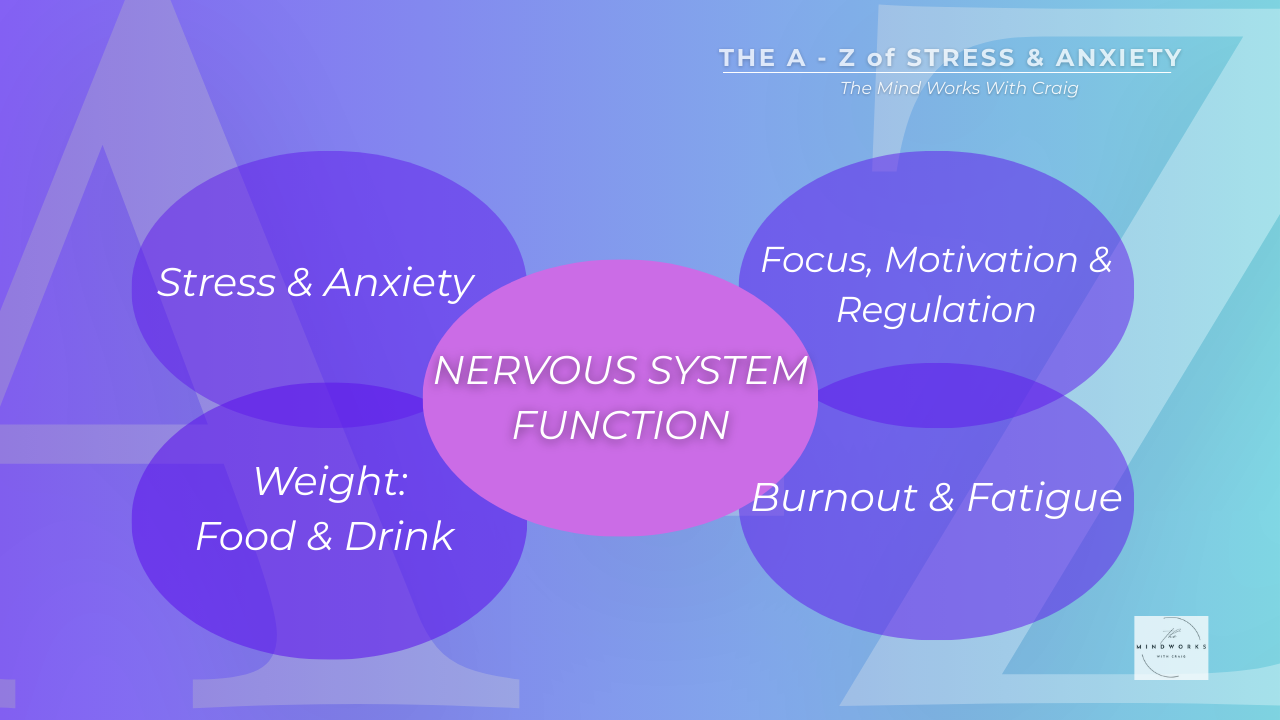
The A–Z of Stress & Anxiety
A Nervous System Function–First Approach
For many people, stress, anxiety, low mood, burnout, procrastination, cravings, sleep disruption and relationship strain appear as separate problems.
We look for coping tools when anxiety rises.
We count calories when weight changes.
We push for more motivation when we already know what we should be doing.
We seek explanations or diagnoses when focus shifts.
When energy drops, we reach for quick relief.
Each of these responses makes sense.
But what if they are not separate problems at all?
What if they are expressions of one system under load?
The A–Z of Stress & Anxiety is built on a simple principle:
Load alters capacity. Capacity shapes behaviour.
This series reframes familiar experiences as reflections of nervous system state rather than personal failure. It sits alongside The Hidden Impact of Stress and forms the practical, applied extension of that model.
Below you’ll find the full A–Z index.
A — Anxiety
https://www.themindworkswithcraig.co.uk/blog/anxiety-nervous-system
Anxiety is often treated as something to eliminate. More accurately, it reflects a nervous system oriented toward perceived threat. This entry explores mobilisation, sympathetic activation, and narrowed tolerance.
B — Burnout
https://www.themindworkswithcraig.co.uk/blog/burnout-nervous-system
Burnout describes prolonged depletion following sustained stress. It is less about weakness and more about recovery lagging behind demand.
C — Cortisol, Cravings & Comfort Seeking
https://www.themindworkswithcraig.co.uk/blog/cortisol-nervous-system
Stress chemistry influences appetite, blood sugar and reward pathways. This entry explains why comfort eating and alcohol reliance often increase under load.
D — Disconnected
https://www.themindworkswithcraig.co.uk/blog/disconnected-nervous-system
Feeling detached from yourself or others can reflect parasympathetic shutdown rather than emotional indifference.
E — Exhaustion
https://www.themindworkswithcraig.co.uk/blog/exhaustion-nervous-system
Exhaustion reflects systemic overload. Ongoing stress depletes energy systems and reduces regulatory flexibility.
F — Fight, Flight and Freeze
https://www.themindworkswithcraig.co.uk/blog/fight-flight-freeze-nervous-system
These survival responses are adaptive. They become problematic only when chronically activated.
G — Guilt
https://www.themindworkswithcraig.co.uk/blog/guilt-nervous-system
Guilt often intensifies under stress, particularly when internal standards remain high while capacity drops.
H — High Alert (Hypervigilance)
https://www.themindworkswithcraig.co.uk/blog/high-alert-nervous-system
Persistent scanning for threat reflects sustained activation and reduced ability to switch off.
I — Intrusive Thoughts & Imposter Syndrome
https://www.themindworkswithcraig.co.uk/blog/intrusive-thoughts-imposter-syndrome-nervous-system
Under stress, identity feels less stable and intrusive thoughts increase as the system seeks certainty.
J — Judgement (Self-Judgement)
https://www.themindworkswithcraig.co.uk/blog/self-judgement-nervous-system
Harsh internal evaluation increases load and narrows emotional safety.
K — Knowing vs Doing
https://www.themindworkswithcraig.co.uk/blog/knowing-versus-doing-nervous-system
Insight does not equal capacity. Stress impairs executive function, reducing follow-through despite understanding.
L — Low Mood
https://www.themindworkswithcraig.co.uk/blog/low-mood-nervous-system
Low mood often emerges secondary to exhaustion, inflammation and reduced reward sensitivity.
M — Mental Overload
https://www.themindworkswithcraig.co.uk/blog/mental-overload-nervous-system
Too much input reduces clarity. Prefrontal fatigue narrows focus and increases overwhelm.
N — Nervous System Impact & Negative Core Beliefs
Repeated stress can imprint beliefs about safety, control and worth through neuroplastic learning.
O — Overthinking and OCD
https://www.themindworkswithcraig.co.uk/blog/overthinking-ocd-nervous-system
Compulsive checking and rumination are attempts to create certainty when threat bias increases.
P — Procrastination, Pressure and Panic
https://www.themindworkswithcraig.co.uk/blog/procrastination-pressure-panic-nervous-system
Avoidance often reflects overload and fear rather than lack of motivation.
Q — Questioning
https://www.themindworkswithcraig.co.uk/blog/questioning-nervous-system
Persistent doubt reflects reduced orientation and intolerance of ambiguity under load.
R — Rumination, Restlessness and Regret
https://www.themindworkswithcraig.co.uk/blog/rumination-restlessness-regret-nervous-system
Repetitive thinking sustains activation and prevents resolution.
S — Sleeplessness and Stress
https://www.themindworkswithcraig.co.uk/blog/sleeplessness-stress-nervous-system
Sleep disruption both causes and results from stress chemistry imbalance.
T — Tension (Physical)
https://www.themindworkswithcraig.co.uk/blog/tension-physical-nervous-system
The body often holds stress that the mind cannot resolve. Muscular guarding becomes habitual.
U — Uncertainty
https://www.themindworkswithcraig.co.uk/blog/uncertainty-nervous-system
When outcomes feel unclear, threat bias increases and clarity narrows.
V — Vagus Nerve
https://www.themindworkswithcraig.co.uk/blog/vagus-nerve-nervous-system
The vagus nerve reflects regulatory flexibility, not simply calmness.
W — Window of Tolerance
https://www.themindworkswithcraig.co.uk/blog/window-of-tolerance-nervous-system
Resilience narrows under sustained load. Reactivity increases when capacity reduces.
X — Stress, Anxiety, Libido & Sex Drive
https://www.themindworkswithcraig.co.uk/blog/stress-anxiety-libido-nervous-system
Sexual interest shifts under stress. Mobilisation and conservation both influence desire.
Y — “You Don’t Understand Me”
https://www.themindworkswithcraig.co.uk/blog/you-dont-understand-me-nervous-system
Relational strain often reflects nervous system load rather than communication failure alone.
Z — Zoned Out
https://www.themindworkswithcraig.co.uk/blog/zoned-out-nervous-system
Shutdown and dissociation reflect protective energy conservation when mobilisation has been prolonged.
Why This Matters
This A–Z is not a diagnostic manual.
It is a map.
It links lived psychological experience to physiological reality.
It explains why anxiety, fatigue, cravings, procrastination, guilt, disconnection and burnout often travel together.
When we treat them separately, progress feels fragmented.
When we recognise them as expressions of nervous system load, the pattern becomes coherent.
Regulation precedes optimisation.
Flexibility indicates capacity.
Capacity shapes behaviour.
If you are unsure where to begin, start with the entry that feels most familiar.
The pattern will often reveal itself from there.
Anxiety, Weight Gain, or Patterns That Feel Stuck?
Understand What May Be Driving Them
Many people approach anxiety and weight loss as separate problems.
In practice, both are often influenced by nervous system load.
When stress remains elevated, blood sugar stability shifts. Cravings increase. Fat burning becomes less efficient. Sleep lightens. Focus narrows. Emotional tolerance reduces.
At the same time, internal conflict intensifies. One "part of you" seeks progress. Another "part of you" seeks relief.
Over time, this can present as anxiety, weight gain, burnout, or more complex patterns that feel resistant to willpower alone.
Understanding how your nervous system is functioning is often the first step toward steadier change.
Stay connected with news and updates!
Join our mailing list to receive the latest news and updates from our team.
Don't worry, your information will not be shared.
We hate SPAM. We will never sell your information, for any reason.