R — Rumination, Restlessness, and Regret: A Nervous System Perspective | The A–Z of Stress & Anxiety
Feb 18, 2026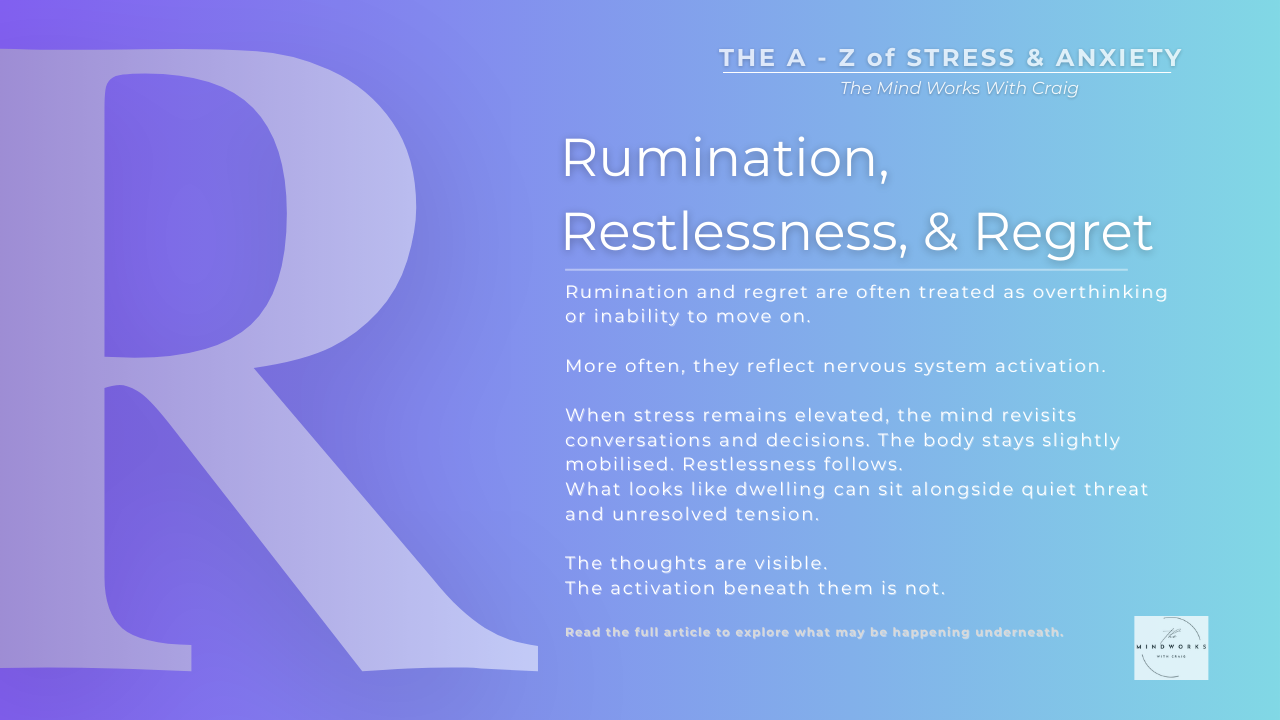
R – Rumination, Restlessness, and Regret
Introduction
The A–Z of Stress & Anxiety is not a diagnostic index. It is a map of common entry points into stress, anxiety, and nervous system strain as they are actually lived. Each letter reflects a recognisable pattern rather than a problem to be solved.
R is one of the most familiar. Rumination, restlessness, and regret often appear quietly and persistently. They do not arrive as crises. They arrive as loops. A thought that returns. A sense of agitation without a clear cause. A lingering feeling that something should have been done differently.
For many people, this is where stress becomes internalised. Less visible, more mental, but no less taxing on the system.
What Rumination, Restlessness, and Regret Often Look Like in Real Life
Rumination rarely feels dramatic. It often presents as a background hum of mental replay.
A conversation that keeps resurfacing. A decision revisited repeatedly. A moment that felt small at the time but now seems loaded with significance. Attention turns inward and circles familiar ground.
Restlessness tends to accompany this. Not always physical, but a sense of being unable to settle. Difficulty relaxing without distraction. The impulse to check, scroll, tidy, move, or mentally rehearse. Stillness feels uncomfortable, even when nothing is actively wrong.
Regret adds a particular emotional tone. It is less about sadness and more about judgement. A sense that a different choice should have been obvious. That something important was missed. That past decisions reflect something flawed about the self.
In practice, these experiences often overlap. Rumination feeds restlessness. Restlessness amplifies regret. Regret pulls attention further inward.
Over time, this can shape behaviour. Avoidance of decisions. Hesitation. Difficulty trusting one’s judgement. Or, conversely, impulsive action as a way of escaping the loop.
What Is Often Misunderstood About This
Rumination is frequently framed as unhelpful thinking that should be stopped. Restlessness is often interpreted as impatience or lack of discipline. Regret is treated as a failure to move on.
These interpretations are understandable, but incomplete.
Rumination is not a mistake of character. It is a function of the mind under load. The brain has systems designed to review, learn, and predict. When stress levels rise, those systems can become overactive.
Telling someone to think differently rarely resolves this, because the process is not primarily cognitive. Effort and logic tend to add pressure rather than relief.
Similarly, regret is often judged harshly. We hold ourselves accountable for not knowing then what we know now. This retrospective judgement ignores the context, resources, and information available at the time decisions were made.
What is often missed is that these patterns are not signs of dysfunction. They are signs of a system attempting to protect, predict, and prevent future threat.
What Is Happening Underneath
From a nervous system perspective, rumination is closely linked to inward-focused attention. The brain’s default mode network becomes more active when external demands reduce or when uncertainty remains unresolved.
This is not inherently problematic. Reflection and learning depend on it. However, under sustained stress, the same circuitry can become repetitive and self-reinforcing.
When emotionally charged memories are replayed, the nervous system responds as if the event is occurring again. Stress chemistry is activated. Heart rate changes. Muscles tense. The body does not distinguish clearly between memory and immediate experience.
A useful analogy is watching a film. We know it is not real, yet our bodies respond. We feel tension, fear, relief. Rumination operates in a similar way, except the screen is internal and the content is personal.
Restlessness emerges as the system remains mobilised. There is energy without a clear outlet. The body prepares for action, but no action resolves the perceived issue.
Regret fits into this pattern through meaning. Decisions are evaluated not only by outcome but by what they appear to say about identity, competence, or worth. The mind overlays narrative onto memory, often with judgement.
Within the Mind Works model, this reflects a mismatch between maps and terrain. We construct mental maps based on past information. Reality unfolds differently. When outcomes diverge from expectation, the mind revisits the map rather than acknowledging that the terrain changed.
How This Fits Within the Mind Works Framework
Rumination often sits within the recurring cycle of stress. It reflects an attempt to regain certainty without addressing underlying load.
From a Tower Block perspective, this pattern commonly appears when someone is functioning but depleted. Not in collapse, but not fully resourced either. There is enough capacity to think, but not enough safety to rest.
Parts of Self are also relevant here. A future-oriented part may be analysing outcomes and consequences. A more vulnerable part may be holding emotional memory. Without integration, these parts speak over one another, creating internal noise rather than clarity.
Psychological processes of distress such as inner conflict, self-judgement, and overestimation of responsibility often reinforce the loop. The more we try to reason our way out, the more pressure we apply to an already taxed system.
Importantly, this is not about faulty thinking. It is about bandwidth.
Orientation Rather Than Solutions
When someone is caught in rumination, the instinct is often to seek techniques. Distraction, reframing, positive thinking, or mental control.
These can help in moments, but they miss the wider orientation.
Before change, there is a need for stabilisation. Understanding what the system is doing and why. Recognising that repetitive thought is not a personal failure, but a signal that safety and certainty feel compromised.
Orientation means noticing patterns without trying to eliminate them. It means acknowledging regret without self-punishment. It means recognising restlessness as energy without direction, rather than a flaw.
When the nervous system begins to feel safer, rumination naturally softens. Not because it is forced to stop, but because it no longer needs to stay alert.
Closing Reflection
Rumination, restlessness, and regret are not signs that something is wrong with you. They are signs that your system is working hard to protect you using limited resources.
For some, these patterns pass as load reduces. For others, they become familiar companions that quietly drain energy over time.
Support that focuses on nervous system stabilisation, orientation, and capacity rather than control can be helpful here. Not to eliminate thought, but to create the conditions where thinking no longer has to work so hard.
This is often where gentle, reset-style support can play a role. Not as a fix, but as a way of helping the system settle enough for perspective to return.
Anxiety, Weight Gain, or Patterns That Feel Stuck?
Understand What May Be Driving Them
Many people approach anxiety and weight loss as separate problems.
In practice, both are often influenced by nervous system load.
When stress remains elevated, blood sugar stability shifts. Cravings increase. Fat burning becomes less efficient. Sleep lightens. Focus narrows. Emotional tolerance reduces.
At the same time, internal conflict intensifies. One "part of you" seeks progress. Another "part of you" seeks relief.
Over time, this can present as anxiety, weight gain, burnout, or more complex patterns that feel resistant to willpower alone.
Understanding how your nervous system is functioning is often the first step toward steadier change.
Stay connected with news and updates!
Join our mailing list to receive the latest news and updates from our team.
Don't worry, your information will not be shared.
We hate SPAM. We will never sell your information, for any reason.