K — Knowing versus Doing: A Nervous System Perspective | The A–Z of Stress & Anxiety
Feb 18, 2026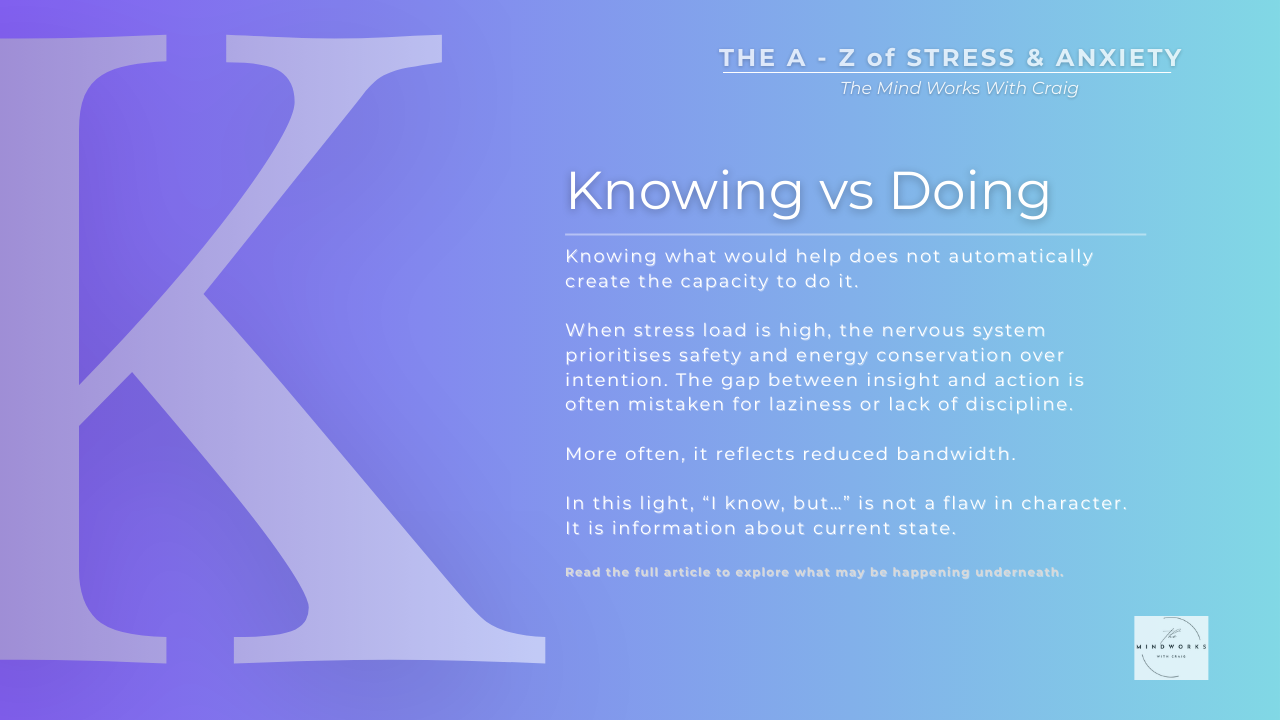
K – Knowing versus Doing
Introduction
Within The A–Z of Stress & Anxiety, each letter names a common point where people begin to notice that something is not quite right. Not a diagnosis, not a failing, but a signal.
Knowing versus doing is one of the most familiar of these entry points. It often appears quietly, wrapped in self-judgement, frustration, or a sense of internal contradiction. People describe understanding exactly what would help, sometimes in great detail, yet finding themselves unable to act on it.
This entry sits close to the heart of stress and anxiety because it reflects an internal split rather than a lack of information. It is not about ignorance. It is about capacity, safety, and internal resources. For many, this tension becomes the background noise of daily life, shaping motivation, confidence, and self-trust long before anxiety is named directly.
What Knowing versus Doing Often Looks Like in Real Life
In everyday language, this experience is usually expressed through a sentence that contains the word but.
“I know what I should do, but…”
“I understand why this matters, but…”
“I’ve read the books, done the courses, but…”
The first part of the sentence is often calm, rational, and well-structured. It reflects the future-oriented part of the mind that can see patterns, consequences, and sensible next steps. The second part is quieter, more ambiguous, and frequently dismissed. It may not arrive as a clear thought at all, but as a hesitation, a heaviness, a sense of threat, or a sudden loss of energy.
People describe:
-
Making plans and lists that never quite translate into action.
-
Feeling frustrated with themselves for “not following through”.
-
Oscillating between bursts of motivation and periods of withdrawal.
-
Avoiding tasks that are logically straightforward.
-
Feeling conflicted about change even when it is clearly beneficial.
Emotionally, this can feel like guilt, shame, or confusion. Physically, it may show up as fatigue, tension, or a sense of being drained before starting. Behaviourally, it often leads to delay, distraction, or retreat. Relationally, it can create a gap between how someone appears to others and how they experience themselves internally.
What is striking is that none of this reflects a lack of insight. In fact, it often appears most strongly in people who are reflective, conscientious, and capable of seeing the bigger picture.
What Is Often Misunderstood About This
The most common misunderstanding is that knowing versus doing is a motivation problem. From this perspective, the solution seems obvious. Try harder. Commit more. Add accountability. Increase discipline.
Another assumption is that the presence of hesitation means resistance, avoidance, or self-sabotage. While these words may describe behaviour, they rarely explain it.
Logic alone struggles here because logic belongs to only one part of the system. It speaks fluently to goals, values, and long-term outcomes, but it does not address whether the system currently has the energy, safety, or bandwidth required to act.
This is why advice that focuses solely on willpower often backfires. It intensifies internal pressure without resolving the underlying conflict. Over time, this can deepen self-judgement and reinforce the belief that something is wrong with the person rather than recognising a mismatch between demand and capacity.
From a stress perspective, knowing versus doing is not a failure of intention. It is a signal that the system is already working hard to manage load.
What Is Happening Underneath
At a deeper level, knowing versus doing reflects two parallel processes running at the same time.
One is future-focused, cognitive, and pragmatic. It assesses what would be helpful, sensible, or necessary. It tends to speak in plans and principles.
The other is present-focused and protective. It monitors energy, threat, and safety. It does not argue logically. Instead, it communicates through sensation, emotion, and impulse.
When stress is low and resources are sufficient, these processes align. Knowing naturally translates into doing. When stress is elevated, alignment breaks down. The protective system quietly signals that something about the proposed action feels unsafe, overwhelming, or unsustainable.
This is not always conscious. The signal may arrive as fatigue, procrastination, anxiety, or a vague sense of unease. Importantly, it often appears before the person has a chance to reason through it. By the time logic enters the picture, the nervous system has already decided that action carries a cost.
From a physiological perspective, chronic stress narrows capacity. Executive function becomes less accessible, energy availability fluctuates, and the system prioritises short-term stability over long-term optimisation. In this context, the inability to act is not defiance. It is conservation.
Seen this way, the word but is not a flaw in thinking. It is a message.
How This Fits Within the Mind Works Framework
Within the Mind Works approach, knowing versus doing sits at the intersection of several core ideas.
It reflects an early stage of internal conflict where the future-oriented self and the current state are no longer aligned. The Tower Block model helps make sense of this. When someone is operating below their stable threshold, they may still think clearly about what would help, but lack the internal conditions required to carry it out consistently.
The Parts of Self perspective adds further clarity. The part that knows what to do is often logical, responsible, and goal-driven. The quieter part that hesitates is often protective, monitoring energy, stress, and perceived threat. When this protective voice is ignored or overridden, it tends to become stronger, not weaker.
Knowing versus doing also appears within the broader psychological processes of distress. It is one of the earliest signs that pressure has begun to exceed capacity. Before anxiety becomes overt, before burnout is recognised, this internal split is often already present.
Understanding this pattern allows it to be held with curiosity rather than judgement. It shifts the question from “Why am I not doing this?” to “What is my system responding to right now?”
Orientation Rather Than Solutions
Because knowing versus doing is so often treated as a problem to fix, it can be tempting to jump straight to strategies. More structure. Better habits. Stronger accountability.
Orientation offers a different starting point.
Instead of trying to close the gap through force, orientation involves noticing where capacity has narrowed and why. It involves recognising that stabilisation often precedes change, not the other way around. When energy, safety, and load are brought back into balance, action tends to follow naturally.
This does not mean waiting passively or avoiding responsibility. It means acknowledging that effective change emerges from a system that feels supported rather than pressured. For many people, this reframing alone reduces a significant amount of internal friction.
Closing Reflection
Knowing versus doing is one of the most common experiences people bring into conversations about stress and anxiety, even if they do not name it as such. It sits quietly beneath self-criticism, productivity struggles, and repeated attempts to “get back on track”.
When understood as an indicator of internal state rather than a personal failing, it becomes informative rather than frustrating. It points toward the need for stabilisation, context, and support that works with the nervous system rather than against it.
For some, this orientation is enough to begin restoring alignment. For others, structured support that focuses on nervous system regulation and internal coherence can provide a clearer starting point. Not as a solution to be imposed, but as a way of creating the conditions in which knowing and doing can meet again.
Anxiety, Weight Gain, or Patterns That Feel Stuck?
Understand What May Be Driving Them
Many people approach anxiety and weight loss as separate problems.
In practice, both are often influenced by nervous system load.
When stress remains elevated, blood sugar stability shifts. Cravings increase. Fat burning becomes less efficient. Sleep lightens. Focus narrows. Emotional tolerance reduces.
At the same time, internal conflict intensifies. One "part of you" seeks progress. Another "part of you" seeks relief.
Over time, this can present as anxiety, weight gain, burnout, or more complex patterns that feel resistant to willpower alone.
Understanding how your nervous system is functioning is often the first step toward steadier change.
Stay connected with news and updates!
Join our mailing list to receive the latest news and updates from our team.
Don't worry, your information will not be shared.
We hate SPAM. We will never sell your information, for any reason.