M — Mental Overload: A Nervous System Perspective | The A–Z of Stress & Anxiety
Feb 18, 2026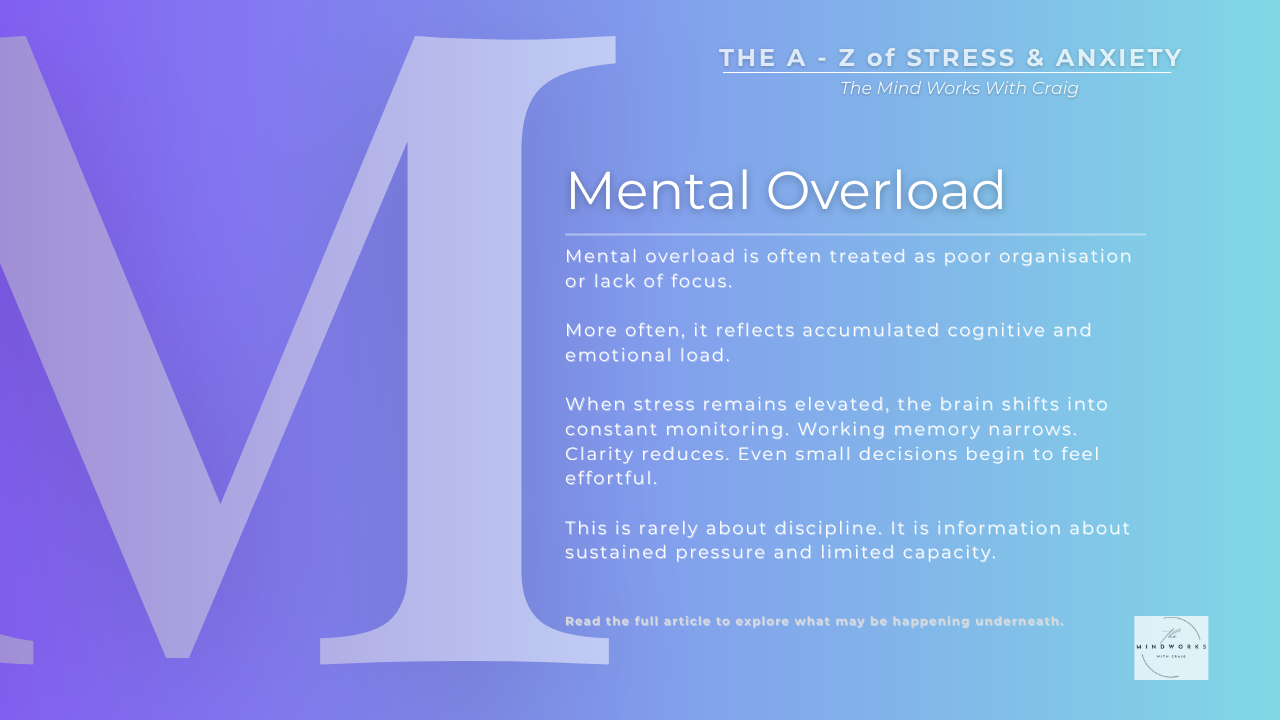
M – Mental Overload
Introduction
This entry is part of The A–Z of Stress & Anxiety, a written series that frames stress and anxiety not as problems to be fixed, but as signals about internal system state, particularly the nervous system.
Each letter names a common point of entry. Something familiar. Something people recognise in themselves long before they would use clinical language.
Mental overload is one of the most common of these entry points. It rarely announces itself as anxiety. More often it shows up as feeling full, crowded, scattered, or mentally heavy. Too much to think about. Too many loose ends. Too many demands competing for limited internal space.
In modern life, mental overload is so widespread that it is often normalised. It becomes the background hum of everyday functioning. This entry explores what mental overload actually looks like, what is often misunderstood about it, and what is happening underneath when the mind feels permanently “too full”.
What Mental Overload Often Looks Like in Real Life
Mental overload is not just about having a lot to do. It is about having too much to hold at once.
People often describe it as feeling mentally cluttered, even when nothing particularly dramatic is happening. Thoughts stack up rather than resolve. Tasks feel unfinished before they even begin. There is a sense of being permanently behind, even when working hard.
Cognitively, this can show up as difficulty concentrating, forgetfulness, indecision, or constantly switching between tasks without completing any of them. People may reread the same email several times, lose their train of thought mid sentence, or feel unable to prioritise even simple decisions.
Emotionally, mental overload often carries a low level of irritability or emotional flattening. Small interruptions feel disproportionately frustrating. There may be a sense of numbness alongside pressure, or a feeling of being strangely detached from things that would normally matter.
Physically, people often notice head pressure, jaw tension, shallow breathing, fatigue, or a wired but tired quality. Sleep may feel unrefreshing, not because of insomnia as such, but because the mind never fully powers down.
Behaviourally, overload can lead to procrastination, avoidance, scrolling, comfort seeking, or repeatedly “doing something” without any sense of progress. Relationally, people may withdraw slightly, feel less patient, or struggle to be present in conversation.
Importantly, none of this requires a crisis. Mental overload often develops quietly, through accumulation.
What Is Often Misunderstood About This
Mental overload is frequently mistaken for poor organisation, lack of discipline, or insufficient motivation.
The assumption is often that the solution is better planning, more productivity tools, or simply trying harder. While structure can help at times, this framing misses something essential.
The overloaded mind is not empty and unfocused. It is full.
Trying to add more strategies, goals, habits, or self improvement tasks can actually increase the load. Advice that centres on optimisation or efficiency often backfires because it fails to account for capacity.
There is also a widespread cultural message that we should always be developing. More skills. More hobbies. More insight. More goals. This message is rarely malicious, but it ignores the reality that development requires spare capacity. When the system is already under pressure, even positive demands can become stressors.
Mental overload is not a failure to cope. It is often a sign that the system has been coping for a long time.
What Is Happening Underneath
At a physiological level, mental overload reflects sustained cognitive demand under stress.
The brain is constantly processing information, predicting outcomes, monitoring threat, and managing social and practical demands. When stress levels rise, more of this processing is directed toward scanning, planning, and problem holding rather than resolution.
The prefrontal cortex, responsible for focus, prioritisation, and decision making, is particularly sensitive to stress chemistry. Cortisol and adrenaline do not simply increase alertness. Over time, they reduce working memory and cognitive flexibility. This makes it harder to hold multiple pieces of information without fatigue.
Mental overload is also closely linked to attentional fragmentation. Modern environments expose us to constant input. Notifications, emails, news, social media, and shifting expectations all compete for attention. Each interruption carries a small cognitive cost. Over time, these costs accumulate.
From a nervous system perspective, overload often reflects a system that does not feel fully safe to disengage. The mind keeps running because there is a sense, often subtle, that something might be missed, dropped, or go wrong.
In my clinical work, I often talk about the “ten pressures we are under right now”. Five external and five internal.
Externally, these commonly include work demands, financial pressure, information overload, relational responsibilities, and environmental stressors. Internally, they often include self expectation, self monitoring, future planning, rumination, and emotional regulation.
Individually, none of these pressures may feel overwhelming. Collectively, they can exceed the system’s bandwidth.
How This Fits Within the Mind Works Framework
Within the Mind Works framework, mental overload often reflects a mismatch between demand and capacity rather than a problem with thinking itself.
In terms of the Process of Change, overload commonly appears in the early stages, when recognition is present but resources are limited. There is awareness, but little space to act on it.
Within the Tower Block, mental overload is often seen in the middle levels. Functioning is still possible, but increasingly effortful. The system is compensating, but at a cost.
From a Parts of Self perspective, overload frequently reflects tension between a future oriented part that is holding plans, goals, and responsibilities, and a protective part that is signalling depletion. When these parts are not aligned, the mind becomes crowded with competing demands.
Mental overload also links closely with psychological processes of distress such as overthinking, pressure, and self judgement. The mind becomes both the manager and the critic, increasing internal load.
Across the Pillars of Health, overload is rarely purely psychological. Sleep, nutrition, movement, and environment all influence cognitive capacity. When one or more pillars are compromised, the mind has to work harder to compensate.
None of this means something is wrong. It means the system is under sustained load.
Orientation Rather Than Solutions
When mental overload is present, orientation matters more than solutions.
The instinct to declutter the mind, fix the problem, or optimise performance is understandable. But without stabilisation, these efforts often add to the pressure.
Orientation involves recognising overload as information rather than a personal failing. It means noticing the accumulation of pressures rather than searching for a single cause. It involves understanding that capacity fluctuates, and that clarity often follows regulation rather than effort.
In this state, doing less can be more stabilising than doing better. Understanding what the system is responding to creates space before change is attempted.
Mental overload often begins to ease not when the mind is forced to work harder, but when it is allowed to feel safer and less scrutinised.
Closing Reflection
Mental overload is one of the quietest expressions of stress. It does not shout. It accumulates.
If you recognise yourself in this description, it may be worth considering support that focuses on stabilising the nervous system rather than fixing the mind. When the system settles, clarity often returns without being forced.
Within the wider Mind Works approach, Reset style support is designed to help people reduce internal load, restore orientation, and regain cognitive space before change is pursued.
Mental overload is not a sign that you are falling behind. It is often a sign that you have been carrying too much for too long.
Anxiety, Weight Gain, or Patterns That Feel Stuck?
Understand What May Be Driving Them
Many people approach anxiety and weight loss as separate problems.
In practice, both are often influenced by nervous system load.
When stress remains elevated, blood sugar stability shifts. Cravings increase. Fat burning becomes less efficient. Sleep lightens. Focus narrows. Emotional tolerance reduces.
At the same time, internal conflict intensifies. One "part of you" seeks progress. Another "part of you" seeks relief.
Over time, this can present as anxiety, weight gain, burnout, or more complex patterns that feel resistant to willpower alone.
Understanding how your nervous system is functioning is often the first step toward steadier change.
Stay connected with news and updates!
Join our mailing list to receive the latest news and updates from our team.
Don't worry, your information will not be shared.
We hate SPAM. We will never sell your information, for any reason.