T — Tension (Physical): A Nervous System Perspective | The A–Z of Stress & Anxiety
Feb 19, 2026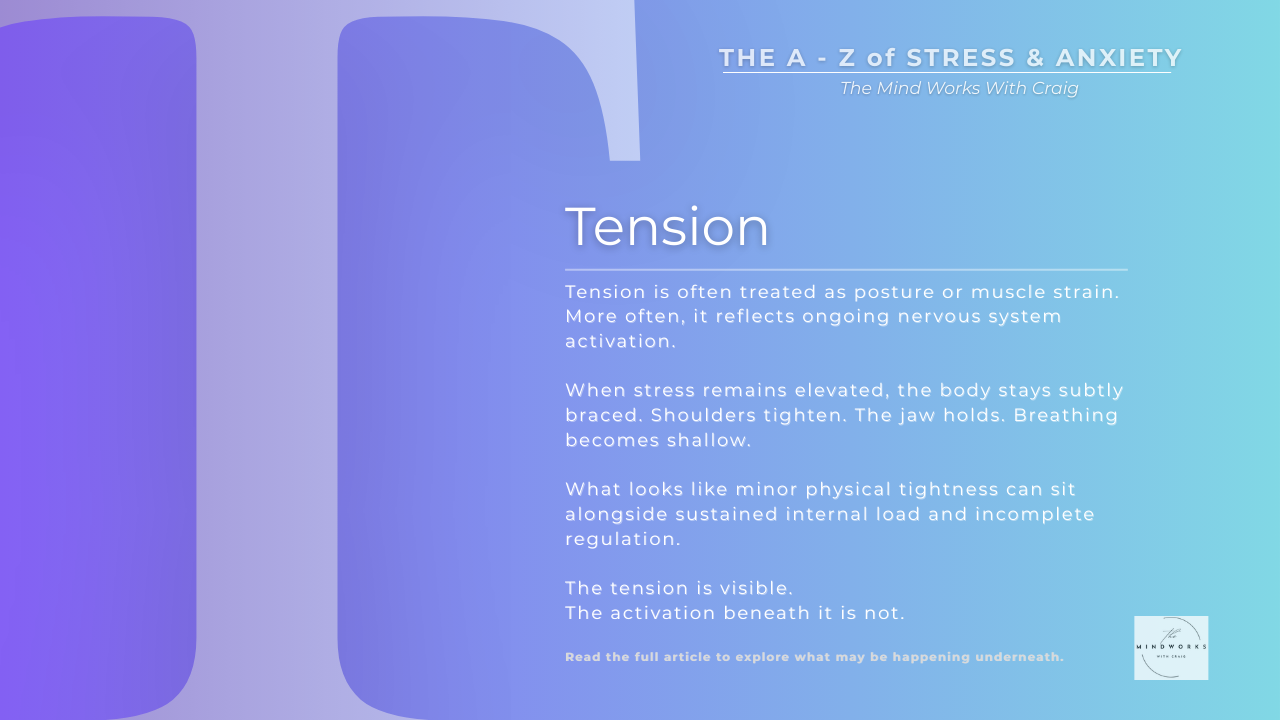
T – Tension (physical)
Introduction
Within The A–Z of Stress & Anxiety, each letter reflects a common way stress first becomes noticeable. Not always as panic or worry, but often as something far more ordinary and easier to dismiss.
Physical tension is one of the most frequent entry points. Tight shoulders. A clenched jaw. A persistent sense of holding on. Many people notice it only in passing, if at all, and assume it is simply part of modern life. Posture, screens, age, workload.
In reality, tension is often one of the earliest ways the nervous system communicates that it is carrying more load than it can comfortably process. It is not a flaw or a failure. It is a signal.
This entry explores physical tension not as a problem to be fixed, but as information about internal state.
What Physical Tension Often Looks Like in Real Life
Physical tension rarely announces itself dramatically. It accumulates quietly and becomes familiar.
It may show up as shoulders that never quite drop, even when resting. A jaw that remains lightly clenched throughout the day. A neck that feels permanently guarded. Shallow breathing without awareness of holding the breath. Hands that are tight rather than relaxed. A stomach that feels braced rather than soft.
For some, tension appears alongside headaches, jaw pain, teeth grinding, digestive discomfort, or restless sleep. For others, it is a vague sense of physical unease that is hard to describe, a feeling of being on edge in the body even when nothing obvious is wrong.
Emotionally, this often coexists with irritability, reduced patience, or a sense of being easily overwhelmed. Cognitively, there may be difficulty concentrating, a sense of mental effort, or the feeling that everything requires more energy than it should.
Behaviourally, people may stretch constantly, fidget, pace, or seek pressure or release without real relief. Others move less, becoming stiff and restricted as holding patterns become ingrained.
Relationally, physical tension can subtly reduce openness. When the body is braced, it is harder to feel ease, connection, or playfulness. Over time, this can contribute to withdrawal or emotional distance without conscious intention.
What Is Often Misunderstood About This
Physical tension is frequently misunderstood as a purely mechanical issue.
It is attributed to poor posture, lack of flexibility, weak core muscles, or insufficient exercise. While these factors can contribute, they rarely explain why tension persists even when people stretch, strengthen, or rest.
Another common assumption is that tension will resolve once life becomes calmer. That once the deadline passes, the workload eases, or the stressor ends, the body will naturally relax. In practice, many people notice that tension remains long after circumstances change.
There is also a belief that awareness alone should be enough. That once someone notices they are tense, they should simply relax. This can lead to frustration when the body does not respond as expected.
What is often missed is that physical tension is not always a conscious choice. It is frequently an automatic protective response that developed gradually in response to ongoing pressure, responsibility, uncertainty, or emotional load.
Effort, logic, or instruction alone rarely unwind patterns that were laid down outside of conscious control.
What Is Happening Underneath
From a physiological perspective, physical tension is closely linked to how the nervous system assesses safety and threat.
When the system perceives pressure, demand, or unpredictability, even at low levels, it subtly shifts toward readiness. Muscles increase tone. Breathing becomes shallower. The body prepares to respond.
In short bursts, this is adaptive. It helps us act, focus, and protect ourselves. The difficulty arises when this state becomes sustained.
Over time, the body learns to remain braced as a default. Muscle groups stay partially activated. Energy is diverted toward vigilance rather than recovery. Inflammation may increase. Digestive processes can be affected. Sexual function and hormonal balance may shift. Sleep becomes less restorative.
Stress chemistry plays a role here. Elevated cortisol and adrenaline support alertness but also maintain muscular guarding. When these systems are repeatedly activated without adequate downregulation, tension becomes habitual rather than situational.
Importantly, the body does not distinguish between physical and psychological threat. Emotional pressure, unresolved conflict, financial uncertainty, and chronic responsibility can all produce the same physical holding patterns as overt danger.
In this way, physical tension is not separate from mental or emotional stress. It is one of its most reliable expressions.
How This Fits Within the Mind Works Framework
Within the Mind Works approach, physical tension is understood as a marker of system load rather than a localised problem.
It often reflects a Tower Block position where the pillars are carrying uneven pressure. Psychological demand, physiological stress, environmental strain, or relational responsibility may all contribute, even if only one is consciously recognised.
From a Parts of Self perspective, tension frequently aligns with a protective function. The body holds because it has learned that staying ready is safer than fully relaxing. This is not a conscious decision, but a learned adaptation.
In terms of the Process of Change, tension often appears early, long before people recognise themselves as stressed or anxious. It is common in the recurring cycle stage, where patterns are active but not yet clearly identified.
Psychological processes of distress such as over-responsibility, suppressed emotion, or internal conflict can all maintain physical holding without obvious emotional expression.
Seen through this lens, tension is not something to battle against. It is something to understand.
Orientation Rather Than Solutions
When physical tension is approached solely as something to release, people often push the body harder. More stretching. More effort. More instruction to relax.
A different orientation begins with stabilisation and context.
Recognising tension as communication changes the relationship to it. Instead of asking how to get rid of it, the more useful question becomes what the system has been carrying.
This shift matters. When the nervous system does not feel heard or understood, it tends to maintain its protective stance. When its signals are acknowledged without judgement, change becomes more possible.
Orientation involves noticing patterns rather than fixing symptoms. When does tension increase. What situations amplify it. How long it has been present. What else is happening in the wider system.
This creates space for regulation rather than control.
Closing Reflection
Physical tension is often one of the earliest signs that the nervous system has been working hard for a long time.
It is easy to dismiss. Easy to normalise. Easy to push through. Yet it frequently reflects an internal state that would benefit from greater support, not greater effort.
Approaches that focus on nervous system stabilisation, rather than symptom suppression, tend to be more effective over time. This may involve creating safety, restoring rhythm, and reducing load rather than forcing release.
For some, gentle, structured Reset-style support can provide a starting point for this process, offering space to understand what the body has been holding and why.
Not to fix tension, but to make sense of it.
Anxiety, Weight Gain, or Patterns That Feel Stuck?
Understand What May Be Driving Them
Many people approach anxiety and weight loss as separate problems.
In practice, both are often influenced by nervous system load.
When stress remains elevated, blood sugar stability shifts. Cravings increase. Fat burning becomes less efficient. Sleep lightens. Focus narrows. Emotional tolerance reduces.
At the same time, internal conflict intensifies. One "part of you" seeks progress. Another "part of you" seeks relief.
Over time, this can present as anxiety, weight gain, burnout, or more complex patterns that feel resistant to willpower alone.
Understanding how your nervous system is functioning is often the first step toward steadier change.
Stay connected with news and updates!
Join our mailing list to receive the latest news and updates from our team.
Don't worry, your information will not be shared.
We hate SPAM. We will never sell your information, for any reason.