Q — Questioning: A Nervous System Perspective | The A–Z of Stress & Anxiety
Feb 18, 2026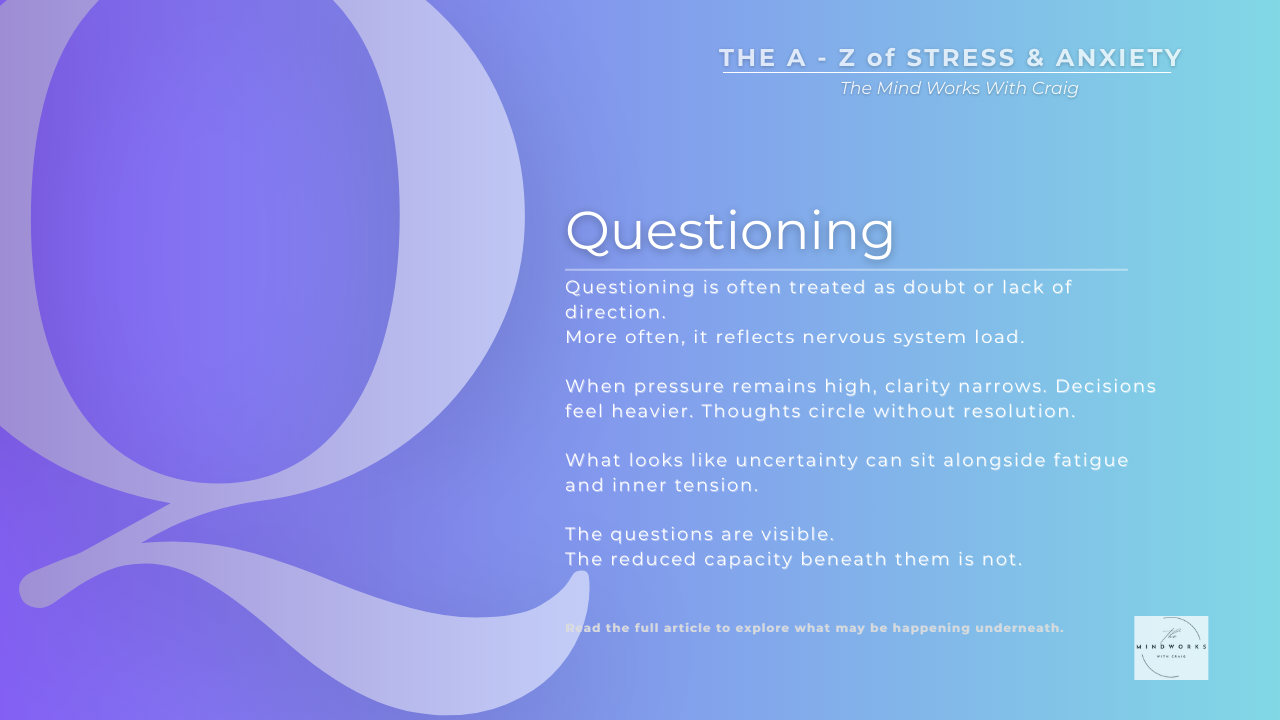
Q – Questioning
Introduction
This entry sits within The A–Z of Stress & Anxiety as an exploration of questioning, not as curiosity or philosophical reflection, but as a particular mental state that often emerges under sustained pressure.
Across this project, stress and anxiety are framed not as faults to correct, but as indicators of internal system state. Questioning is one such indicator. It tends to appear later in the stress cycle, often after prolonged effort, confusion, or depletion, and it can quietly signal that clarity, energy, and orientation have begun to erode.
Rather than asking what is wrong with this experience, it can be more useful to ask what it is responding to.
What Questioning Often Looks Like in Real Life
Questioning rarely arrives all at once. It often builds slowly, woven into everyday thought.
People describe feeling mentally foggy, indecisive, or strangely uncertain about things that once felt obvious. Decisions that would previously have been straightforward begin to feel heavy. Even small choices can feel loaded with consequence.
Internally, there may be a sense of friction. A person knows what they should be doing, or what would make sense on paper, yet feels unable to align with it. This can create repeated internal debates, a looping back over the same thoughts, or a constant weighing up without resolution.
Emotionally, questioning often carries fatigue rather than urgency. There can be a flattening of motivation, a sense of going through the motions, or a growing detachment from outcomes. Over time, this may tip into more existential territory. Questions such as “What is the point?” or “Why am I bothering?” can start to surface.
Relationally, this state can show up as withdrawal or irritability. Conversations may feel effortful. The desire to explain oneself or engage meaningfully can fade, replaced by a wish to conserve what little energy remains.
None of this is dramatic or acute. That is precisely why it is often overlooked.
What Is Often Misunderstood About This
Questioning is frequently interpreted as a motivation problem, a confidence issue, or a failure of discipline. The assumption is that clearer thinking should follow more effort, more analysis, or better planning.
From that perspective, questioning can be treated as something to push through or correct. People may try to force clarity by thinking harder, setting new goals, or demanding certainty from themselves.
What is often missed is that questioning does not usually arise from a lack of intelligence or commitment. It arises from load.
When the system is under sustained pressure, the capacity to hold complexity, tolerate ambiguity, and integrate emotion with logic reduces. At that point, reasoning alone is rarely enough to restore clarity.
This is why advice focused purely on mindset, motivation, or positive thinking often feels hollow or frustrating when someone is in this state.
What Is Happening Underneath
Under stress, the brain prioritises safety over reflection.
As pressure builds, threat-detection systems become more active. This is not confined to dramatic danger. Ongoing demands, emotional strain, uncertainty, and lack of recovery all contribute to the same physiological effect.
The amygdala and related stress circuitry increase their influence, while activity in the areas of the brain responsible for executive function, perspective-taking, and flexible reasoning reduces. In simple terms, the brain becomes less able to hold the bigger picture.
At the same time, energy availability matters. Cognitive clarity is metabolically expensive. When sleep, recovery, nutrition, or emotional bandwidth are compromised, the brain naturally shifts toward more conservative functioning.
Questioning often emerges at this intersection. There is enough awareness to notice that something is not right, but not enough internal resource to resolve it cleanly.
As this continues, inner conflict tends to increase. The rational part of the mind pushes forward with what should be done, while another part signals caution, exhaustion, or threat. If this conflict persists, fatigue deepens and questioning becomes broader and more existential.
At this point, long-standing negative core beliefs may quietly reassert themselves. Doubts about competence, worth, or purpose can be reinforced, not because they are accurate, but because the system no longer has the capacity to challenge them effectively.
How This Fits Within the Mind Works Framework
Within the Mind Works lens, questioning often marks a loss of orientation rather than a lack of insight.
It commonly appears when someone has been operating high in effort for a long period, often driven by responsibility, standards, or necessity. As the internal load increases, the Tower Block becomes less stable. Cognitive clarity drops before emotional collapse does.
From a Parts of Self perspective, questioning reflects tension between the future-oriented, rational self and the current self that is signalling depletion or threat. Neither is wrong. They are simply operating with different information.
In terms of the Process of Change, questioning often sits within the Observing stage. It represents the moment where old strategies no longer work automatically, but new ones have not yet formed. This can feel unsettling, particularly for people used to certainty or control.
Seen this way, questioning is not a failure state. It is a signal that the system is asking for reorientation.
Orientation Rather Than Solutions
When questioning dominates, the instinct is often to search for answers or fixes. However, clarity rarely returns through force.
At this stage, stabilisation tends to matter more than problem-solving. Understanding what has led to this state, how long pressure has been building, and where recovery has been missing can be more useful than deciding what to do next.
Orientation involves recognising that reduced clarity is an expected response to sustained load. It means acknowledging that the system may need support before it can generate meaningful answers.
This is not about lowering standards or giving up. It is about restoring enough internal safety and energy for thinking to become reliable again.
Closing Reflection
Persistent questioning is often misunderstood because it sounds intellectual, when in reality it is physiological and psychological.
When the nervous system has been under strain for long enough, certainty gives way to doubt, and effort gives way to fatigue. Seen through this lens, questioning becomes information rather than a problem.
Support that focuses on nervous system stabilisation, load reduction, and restoring internal resources can be appropriate at this point. For some, this may involve structured, contained support designed to help re-establish clarity and orientation before any attempt at change.
Within The A–Z of Stress & Anxiety, questioning is not an endpoint. It is a signpost indicating that the system is asking for attention.
Anxiety, Weight Gain, or Patterns That Feel Stuck?
Understand What May Be Driving Them
Many people approach anxiety and weight loss as separate problems.
In practice, both are often influenced by nervous system load.
When stress remains elevated, blood sugar stability shifts. Cravings increase. Fat burning becomes less efficient. Sleep lightens. Focus narrows. Emotional tolerance reduces.
At the same time, internal conflict intensifies. One "part of you" seeks progress. Another "part of you" seeks relief.
Over time, this can present as anxiety, weight gain, burnout, or more complex patterns that feel resistant to willpower alone.
Understanding how your nervous system is functioning is often the first step toward steadier change.
Stay connected with news and updates!
Join our mailing list to receive the latest news and updates from our team.
Don't worry, your information will not be shared.
We hate SPAM. We will never sell your information, for any reason.