I — Intrusive Thoughts and Imposter Syndrome: A Nervous System Perspective | The A–Z of Stress & Anxiety
Feb 17, 2026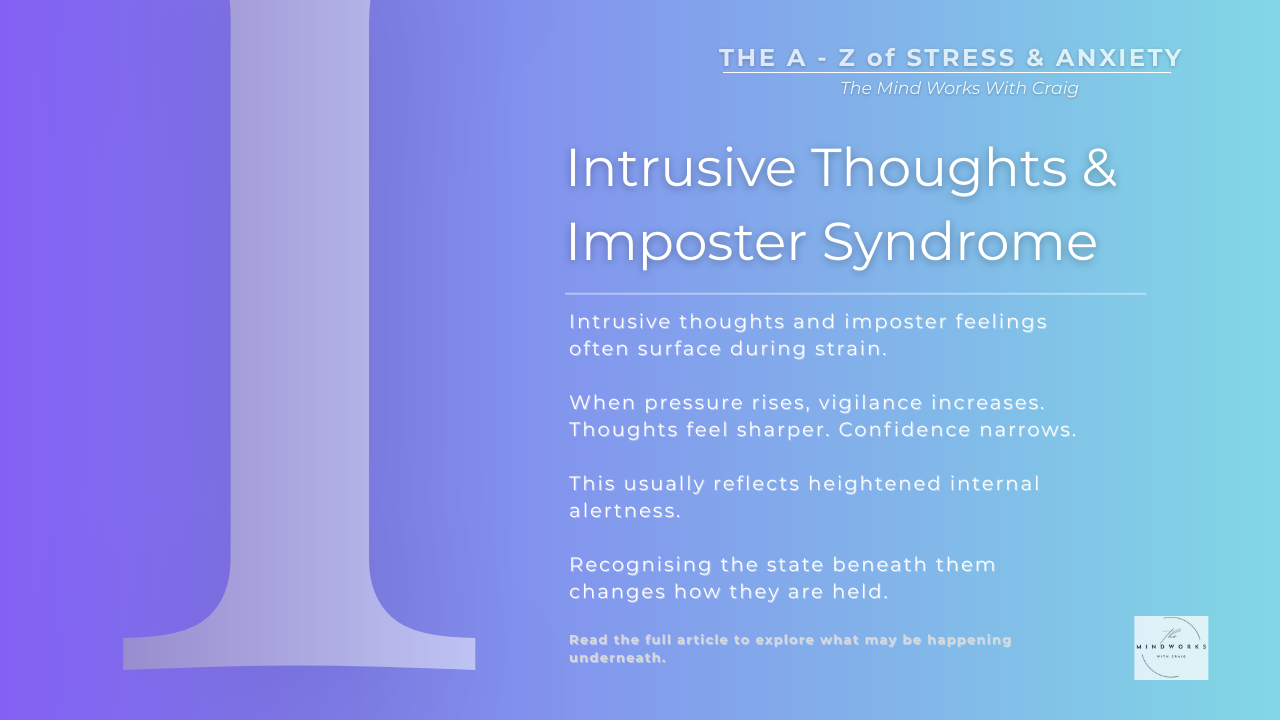
I – Intrusive Thoughts and Imposter Syndrome
Introduction
This entry forms part of The A–Z of Stress & Anxiety, a written project that approaches stress and anxiety as indicators of internal system state rather than problems to be fixed. Each letter names a common way stress shows up in everyday life, offering language and orientation rather than labels or solutions.
For the letter I, the focus is on intrusive thoughts and imposter syndrome. These experiences are often treated as separate issues, one framed as an anxiety problem and the other as a confidence problem. In practice, they frequently travel together. Both tend to emerge when the nervous system is under load and when a person’s sense of safety, competence, or belonging feels threatened.
This letter explores how intrusive thoughts and imposter feelings can be understood as signals of stress, identity pressure, and system strain, rather than evidence that something is fundamentally wrong.
What Intrusive Thoughts and Imposter Syndrome Often Look Like in Real Life
In real life, intrusive thoughts are rarely dramatic or exotic. More often, they show up as brief, unwanted mental intrusions that feel jarring or disturbing precisely because they do not fit with a person’s values or intentions.
These might include sudden thoughts of saying or doing something inappropriate, fears of upsetting or perhaps even harming someone despite having no desire to do so, or repetitive “what if” scenarios that appear uninvited. The distress tends to come not from the content alone, but from the meaning attached to having the thought at all. People often tell me, “I don’t understand why my mind would even go there.”
Imposter syndrome has a different flavour but a similar impact. It often appears as a persistent sense of being found out, exposed, or only just getting away with things. Achievements are discounted. Praise is deflected. Success is attributed to luck, timing, or other people’s lowered standards rather than personal capability.
In daily life, this can look like over-preparing, difficulty resting, reluctance to put oneself forward, or a constant internal pressure to prove worth. It may also show up after promotion, during periods of transition, or when responsibility increases, even when external performance remains strong.
Both experiences commonly coexist with physical signs of stress. Tightness in the chest or jaw, shallow breathing, disrupted sleep, mental fatigue, and a sense of being mentally “on edge” are frequently reported. Behaviourally, people may avoid certain tasks, seek reassurance, or mentally rehearse conversations long after they are over.
What Is Often Misunderstood About This
A common misunderstanding is that intrusive thoughts reveal hidden desires or moral flaws. This belief alone can turn a fleeting mental event into a source of ongoing distress. In reality, the presence of an intrusive thought says very little about character or intention.
Similarly, imposter syndrome is often framed as a confidence deficit that can be solved through positive thinking or repeated affirmation. While reassurance can feel briefly helpful, it rarely settles the underlying experience for long. The doubt tends to return, often louder than before.
Both experiences are also frequently approached through logic. People try to argue with their thoughts, prove themselves wrong, or accumulate evidence that they are competent and safe. While understandable, this strategy can backfire under stress. When the nervous system is activated, rational counter-arguments often struggle to land.
What is missed in these approaches is the role of internal state. When energy is low, pressure is high, or safety feels compromised, the mind tends to become more vigilant and self-referential. In that context, intrusive thoughts and imposter feelings make more sense as protective signals rather than errors to be corrected.
What Is Happening Underneath
Underneath both intrusive thoughts and imposter syndrome sits a common theme of perceived threat, often related to identity, responsibility, or belonging.
From a nervous system perspective, stress shifts the brain toward threat detection. Attention narrows. The mind scans for what could go wrong. Thoughts become stickier and more repetitive. This is not a flaw in the system but a survival-oriented response designed to reduce risk.
Intrusive thoughts tend to arise when this threat monitoring becomes overly internalised. The brain generates mental “test scenarios” and flags them as important because of their emotional charge. The more significance is attached to the thought, the more the system learns to keep checking for it.
Imposter syndrome often reflects a similar process, but focused on social and performance-related safety. When stakes feel high, the system becomes alert to the possibility of rejection, failure, or loss of status. Self-doubt becomes a way of staying vigilant, keeping standards high, and avoiding perceived danger.
Energy and load matter here. When someone is rested, supported, and resourced, these mental patterns often soften. When exhausted, overstretched, or under sustained pressure, they intensify. This is one reason why imposter feelings frequently flare during periods of success rather than failure.
At a psychological level, these experiences can also interact with earlier learning about worth, responsibility, and acceptance. Under stress, those patterns are more easily activated, even if they are usually held lightly or remain in the background.
How This Fits Within the Mind Works Framework
Within the Mind Works approach, intrusive thoughts and imposter syndrome are understood less as isolated problems and more as expressions of system strain.
They often appear during the Preparing or Observing phases of change, when awareness is increasing but capacity has not yet caught up. In Tower Block terms, they are commonly seen around mid-level instability, where someone is still functioning but carrying a high internal load.
From a Parts of Self perspective, imposter feelings can be understood as a protective response. One part of the system is attempting to prevent failure or rejection by maintaining pressure and vigilance. Intrusive thoughts can be seen in a similar light, as alarm signals generated by a system oriented toward preventing harm.
Psychological processes such as overthinking, harsh self-evaluation, and threat-based attention often amplify both experiences. When combined with physiological stress, poor sleep, or depleted energy reserves, the overall effect is a narrowing of perspective and increased self-monitoring.
Importantly, none of this suggests pathology. It suggests a system doing its best under pressure.
Orientation Rather Than Solutions
When intrusive thoughts or imposter syndrome are present, the instinct is often to try to eliminate them. Yet attempting to control or suppress these experiences can unintentionally reinforce them, especially when the system is already under strain.
Orientation offers a different starting point. Rather than asking, “How do I stop this?”, the question becomes, “What might this be telling me about my current load, energy, or sense of safety?”
Stabilisation tends to come before change. When the nervous system settles, intrusive thoughts often lose their intensity and imposter feelings become less convincing. This does not require forcing confidence or analysing every thought, but supporting the conditions in which the system no longer needs to stay on high alert.
Understanding the role of stress chemistry, identity pressure, and internal protection can reduce the fear attached to these experiences. Once fear decreases, the thoughts themselves usually carry less weight.
Closing Reflection
Intrusive thoughts and imposter syndrome can feel deeply personal, as though they reveal something uncomfortable or untrue about who a person is. Viewed through the lens of stress and nervous system load, they tell a different story.
They suggest a system working hard to protect, to anticipate risk, and to maintain safety under pressure. When that pressure is acknowledged and addressed, these experiences often soften without needing to be fought.
For some, support that focuses on stabilisation, regulation, and understanding the wider system can be a helpful next step. Approaches that prioritise nervous system settling rather than symptom control tend to create space for clarity to return, often more naturally than expected.
Anxiety, Weight Gain, or Patterns That Feel Stuck?
Understand What May Be Driving Them
Many people approach anxiety and weight loss as separate problems.
In practice, both are often influenced by nervous system load.
When stress remains elevated, blood sugar stability shifts. Cravings increase. Fat burning becomes less efficient. Sleep lightens. Focus narrows. Emotional tolerance reduces.
At the same time, internal conflict intensifies. One "part of you" seeks progress. Another "part of you" seeks relief.
Over time, this can present as anxiety, weight gain, burnout, or more complex patterns that feel resistant to willpower alone.
Understanding how your nervous system is functioning is often the first step toward steadier change.
Stay connected with news and updates!
Join our mailing list to receive the latest news and updates from our team.
Don't worry, your information will not be shared.
We hate SPAM. We will never sell your information, for any reason.