G — Guilt: A Nervous System Perspective | The A–Z of Stress & Anxiety
Feb 17, 2026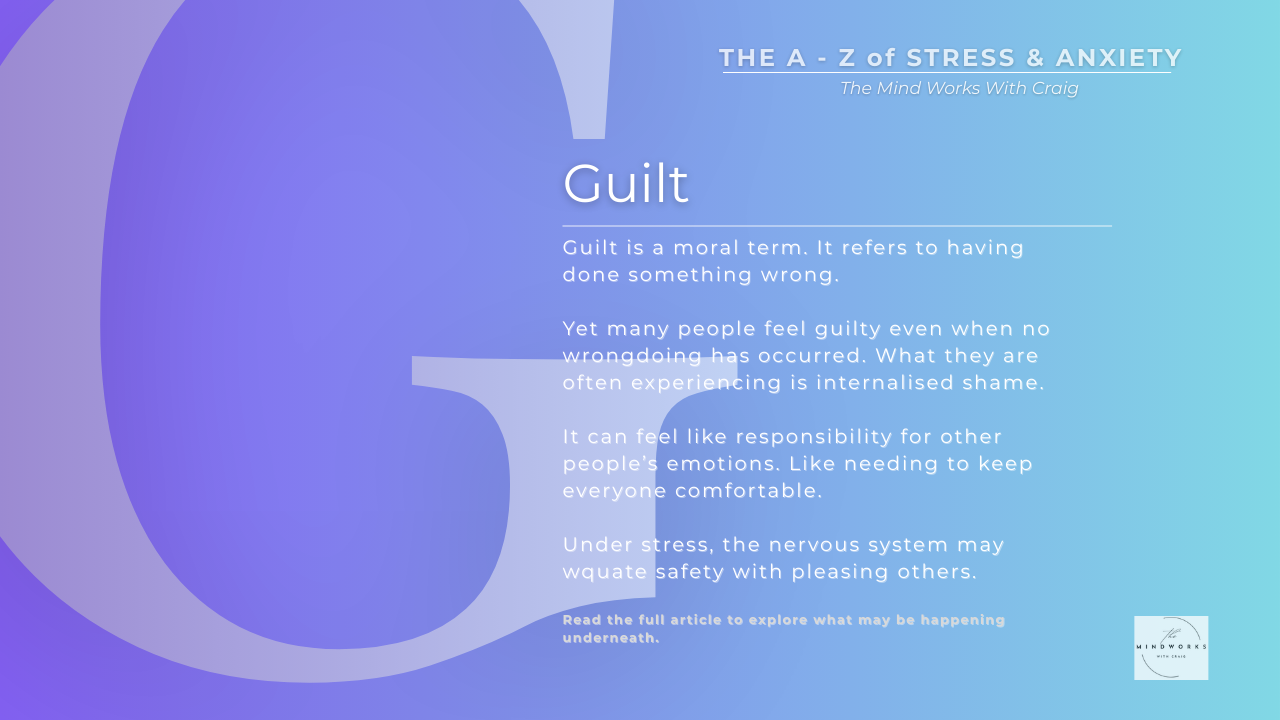
G – Guilt
Introduction
The A–Z of Stress & Anxiety is not intended as a catalogue of problems, but as a map of how stress shows up in real human systems. Each letter names a common experience that often brings people to reflect, seek clarity, or ask whether something is wrong.
Guilt is one of those experiences. It appears frequently in conversations about stress and anxiety, yet it is rarely examined carefully. Many people describe themselves as “feeling guilty” without ever having done anything that would meet the actual definition of guilt.
This entry looks at that gap. Not to correct language for the sake of it, but because misnaming what is happening internally often increases distress rather than reducing it. When guilt is used to describe something else, the nervous system stays under pressure, even when behaviour is conscientious, kind, and thoughtful.
What Guilt Often Looks Like in Real Life
The experience usually described as guilt often has a very particular flavour. It shows up as a constant sense of responsibility for the feelings, comfort, or stability of others. A subtle but persistent internal pressure to keep everyone around you okay.
People describe feeling uneasy when saying no, even to reasonable requests. There may be a sense of tension when prioritising rest, enjoyment, or personal needs. Pleasure itself can feel uncomfortable, as though it requires justification or permission.
Cognitively, this can look like scanning for what others might need, anticipating disappointment, or replaying conversations to check whether something was said wrongly. Emotionally, there is often a low-grade heaviness or unease rather than sharp remorse.
Relationally, it frequently leads to people pleasing or fawning. Going along with things to avoid conflict. Soothing others before they have even expressed discomfort. Taking responsibility for dynamics that are not actually yours to carry.
Physically, this state often comes with tension in the chest or stomach, shallow breathing, and a sense of vigilance rather than ease. The body stays alert, as if something important might go wrong if attention drops.
This does not feel like having done something wrong. It feels like being wrong if something goes wrong.
What Is Often Misunderstood About This
Guilt is a legal and moral term. It refers to having done something that is genuinely wrong, harmful, or unethical. When guilt is appropriate, it tends to be specific, time-limited, and action-oriented. It points toward repair, responsibility, or learning.
What many people experience instead is global, vague, and persistent. It does not resolve when behaviour is reasonable or kind. It is not relieved by apology or correction. In fact, it often intensifies the more effort is made to keep everyone happy.
This is where advice about boundaries, confidence, or self-esteem often falls short. The issue is not a lack of understanding. Most people experiencing this are highly aware, considerate, and reflective. The difficulty is not effort or insight.
Trying harder to be reasonable with yourself rarely settles this feeling. That can be confusing and frustrating, especially for people who are used to solving problems through thoughtfulness and responsibility.
The misunderstanding lies in assuming that this is a thinking problem, when it is primarily a safety problem.
What Is Happening Underneath
The experience described as guilt here is more accurately understood as internalised shame. Shame is not about what you have done, but about who you are perceived to be. It is an intolerable internal state for the nervous system because it signals threat to belonging, safety, and acceptance.
When shame is active, the system becomes oriented toward preventing disconnection. The body prioritises appeasement, harmony, and vigilance over rest or authenticity. People pleasing and fawning are not character flaws, but adaptive strategies designed to maintain safety.
Stress chemistry plays a role. Chronic activation of stress responses sensitises self-referential processing. The mind becomes more attuned to potential rejection or disapproval, even when none is explicitly present. Energy is diverted toward monitoring and away from ease.
Over time, the system learns that being attuned to others is safer than being attuned to self. The internal signal becomes not “I did something wrong”, but “I might be wrong”. That distinction matters.
This is why the feeling persists even in calm environments or supportive relationships. The nervous system is responding to an internalised template, not the present moment.
How This Fits Within the Mind Works Framework
Within the Mind Works lens, this experience sits at the intersection of Parts of Self and the Psychological Processes of Distress. The part oriented toward safety and connection becomes dominant, while other needs recede.
In Tower Block terms, this often appears in the mid-levels, where functioning is intact but effortful. Life continues, responsibilities are met, but there is little sense of ease. Energy is spent managing internal pressure rather than moving upward toward growth or enjoyment.
Within the Process of Change, this experience often shows up before conscious awareness. People may not identify it as distress, because it has been normalised for so long. It is simply “how I am”.
The Pillars of Health are affected quietly. Emotional load increases. Recovery reduces. Relational patterns become shaped by avoidance of discomfort rather than mutual presence.
Importantly, this is not pathology. It is coherence. The system is doing what it learned to do in order to stay safe.
Orientation Rather Than Solutions
When the experience is mislabelled as guilt, people often push themselves to be less sensitive, more confident, or more assertive. That approach tends to increase strain.
Orientation begins with recognising what the feeling actually is. Not as a fault, but as information. A signal that the system has learned to equate safety with self-erasure or over-responsibility.
Stabilisation comes before change. Understanding precedes effort. When the nervous system feels less under threat, the compulsion to manage others’ feelings softens naturally.
This is not about correcting behaviour. It is about reducing internal load so that choice becomes possible again.
Closing Reflection
If guilt feels constant, vague, or tied to the emotions of others rather than specific actions, it may be worth pausing before trying to fix it. What looks like guilt is often a sign of a system that has been carrying responsibility for too long.
Support that focuses on nervous system stabilisation, rather than self-improvement, can create space for this to shift. Not by force, but by restoring a sense of internal safety.
Within the wider A–Z of Stress & Anxiety, guilt is one of many ways the system signals strain. When approached with understanding rather than pressure, it can become a doorway rather than a burden.
Anxiety, Weight Gain, or Patterns That Feel Stuck?
Understand What May Be Driving Them
Many people approach anxiety and weight loss as separate problems.
In practice, both are often influenced by nervous system load.
When stress remains elevated, blood sugar stability shifts. Cravings increase. Fat burning becomes less efficient. Sleep lightens. Focus narrows. Emotional tolerance reduces.
At the same time, internal conflict intensifies. One "part of you" seeks progress. Another "part of you" seeks relief.
Over time, this can present as anxiety, weight gain, burnout, or more complex patterns that feel resistant to willpower alone.
Understanding how your nervous system is functioning is often the first step toward steadier change.
Stay connected with news and updates!
Join our mailing list to receive the latest news and updates from our team.
Don't worry, your information will not be shared.
We hate SPAM. We will never sell your information, for any reason.