J — [Self] Judgement: A Nervous System Perspective | The A–Z of Stress & Anxiety
Feb 18, 2026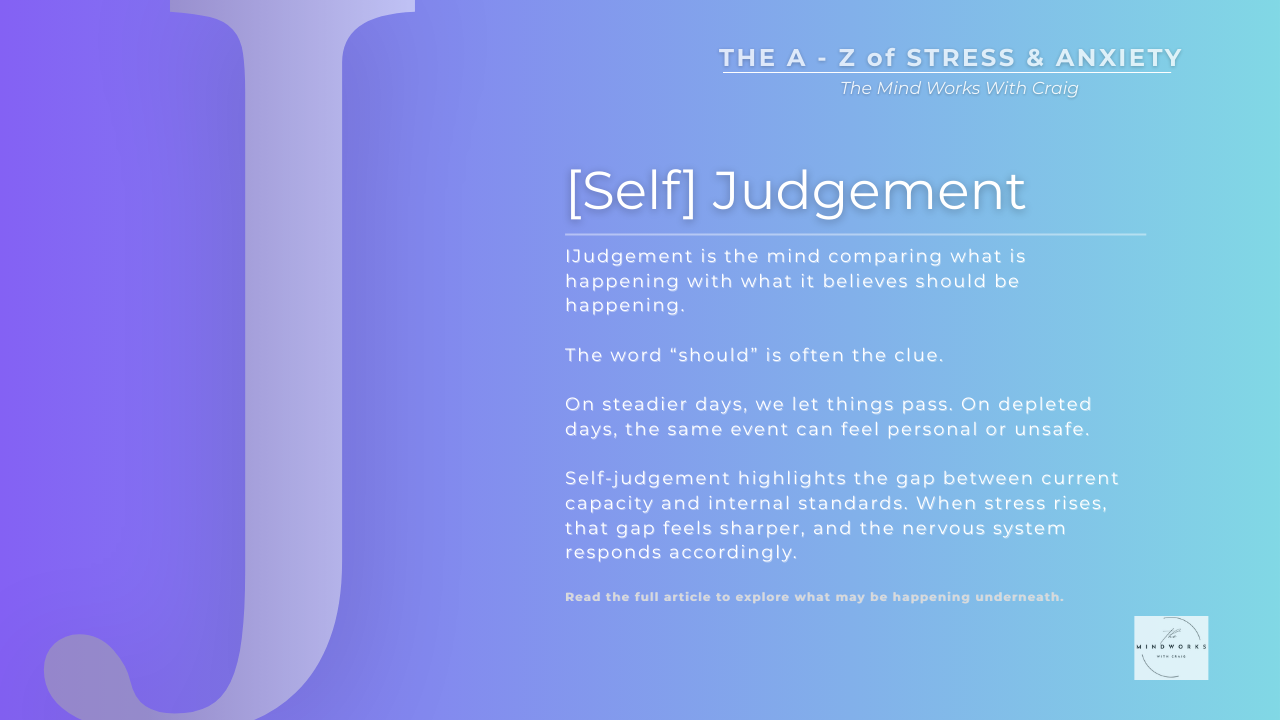
J – Judgement (and Self-Judgement)
Introduction
This entry sits within The A–Z of Stress & Anxiety as one of the quieter but more pervasive ways stress shows itself. Judgement rarely announces itself as anxiety. It often arrives disguised as logic, standards, realism, or responsibility. It can feel like clarity rather than strain.
Across this project, stress and anxiety are explored not as problems to be fixed, but as indicators of internal system state. Judgement is one such indicator. It reflects how the mind and nervous system are assessing the present moment when resources are stretched, safety feels uncertain, or load exceeds capacity.
For many people, judgement is not experienced as something happening to them. It feels like simply “seeing things as they are”. That is precisely why it is such a powerful entry point.
What Judgement Often Looks Like in Real Life
Judgement shows up in everyday language and internal commentary. It often begins with the word should.
“I should be coping better.”
“I shouldn’t feel like this.”
“I should have moved past this by now.”
“I should be more resilient.”
“I should know better.”
Externally, judgement can appear as irritation, criticism, impatience, or a tightening intolerance toward others. Internally, it more often turns inward. A running assessment of performance, progress, emotional state, or capacity.
On some days, a comment, delay, or minor setback is shrugged off with ease. On others, the same experience lands heavily, almost as if it carries personal meaning or threat. The external situation may be similar. The internal response is not.
People often describe feeling harsher with themselves when tired, depleted, overwhelmed, or under pressure. Thoughts become less flexible. Standards rise just as capacity falls. There may be a sense of constantly falling short of an invisible line.
Physically, judgement can be accompanied by tension, jaw clenching, shallow breathing, or a feeling of being “on edge”. Behaviourally, it can lead to overcompensating, pushing through, withdrawing, or avoiding situations that might expose perceived inadequacy.
Relationally, judgement can create distance. Either through criticism of others, or through self-containment and silence driven by fear of being seen as failing.
What Is Often Misunderstood About This
Judgement is often mistaken for motivation or discipline. Many people believe that if they stop judging themselves, standards will drop and progress will stall. Self-criticism is framed as necessary pressure.
Another common misunderstanding is that judgement reflects truth. That it is an accurate appraisal of reality rather than a state-dependent interpretation of it.
From this perspective, the solution seems obvious. Think differently. Be kinder to yourself. Challenge the thoughts. Replace them with more balanced ones. While these approaches can be helpful at times, they often fail when judgement is driven by nervous system strain rather than faulty reasoning.
When stress load is high, the brain’s capacity for nuance reduces. Effort alone does not restore perspective. In fact, trying harder to override judgement can become another standard to fail.
Judgement persists not because people are unwilling to change their thinking, but because the system generating the judgement is under pressure.
What Is Happening Underneath
The human brain is a prediction machine. Its primary task is to assess the current situation and anticipate what comes next, based on past experience and present conditions.
Crucially, these predictions are shaped not only by history, but by current resources. Energy, sleep, stress chemistry, emotional load, and perceived safety all influence how the world is interpreted.
When resources are sufficient, the brain allows for flexibility. Ambiguity is tolerated. Mistakes are contextualised. When resources are depleted, prediction becomes sharper and more rigid. The margin for error narrows.
Judgement emerges at the point where there is a perceived mismatch between what is happening now and what should be happening. That mismatch is registered as a problem to be corrected.
Self-judgement is particularly potent because it reflects an internal comparison. The current, lived experience is measured against an internalised future or ideal version of the self. When stress is high, this comparison becomes less forgiving and more absolute.
From a nervous system perspective, this often coincides with a shift toward threat-based processing. The system is less concerned with growth or learning and more focused on preventing error, loss, or exposure. Judgement functions as an attempt to regain control.
This is why the same situation can feel manageable one day and intolerable the next. The event has not changed. The system interpreting it has.
How This Fits Within the Mind Works Framework
Within the Mind Works approach, judgement is understood as a signal rather than a flaw.
It reflects a gap between the current or actual self and the future or ideal self, a gap that becomes more salient as stress increases. In the Tower Block model, this often corresponds to movement down levels, where access to flexibility, perspective, and long-term thinking reduces.
From a Parts of Self perspective, judgement frequently arises from the part oriented toward standards, responsibility, and future outcomes. When under pressure, this part can lose contact with the lived reality of the present self and begin issuing demands rather than guidance.
Judgement also overlaps with several psychological processes of distress, particularly those involving overused positive attributes such as responsibility, high standards, or self-control. Qualities that are adaptive at one level of stress become punishing at another.
Seen through the Process of Change, judgement often appears early, before recognition and stabilisation have fully occurred. The system attempts to leap straight to managing or overcoming without first assessing capacity.
Rather than something to eliminate, judgement becomes information about load, alignment, and readiness.
Orientation Rather Than Solutions
When judgement is present, the temptation is to correct it. To replace it with compassion, logic, or better thinking.
Orientation takes a different stance. Instead of asking how to stop judging, it asks what the judgement is pointing to.
Is there a mismatch between demand and capacity?
Is the system operating as if there is less safety than there actually is?
Has energy, rest, or support been underestimated?
Is the internal standard based on a different context or phase of life?
This is not about excusing everything or abandoning responsibility. It is about recognising that self-judgement often intensifies when stabilisation is needed first.
Understanding judgement as a state-dependent response allows it to soften without being argued with. Perspective returns as the system settles, not because the standard was forcibly removed.
Closing Reflection
Judgement, especially self-judgement, is often treated as a personal failing or a mindset problem. Within this project, it is framed differently. As an indicator of how the system is coping in that moment.
When judgement becomes loud, repetitive, or harsh, it may be signalling that nervous system support and stabilisation are more relevant than self-improvement strategies.
For some, this recognition alone creates relief. For others, it opens the door to forms of support that prioritise regulation, orientation, and capacity rather than performance.
This is the spirit in which Reset-style support sits. Not as a fix for judgement, but as a way of addressing the conditions that allow judgement to loosen its grip.
Anxiety, Weight Gain, or Patterns That Feel Stuck?
Understand What May Be Driving Them
Many people approach anxiety and weight loss as separate problems.
In practice, both are often influenced by nervous system load.
When stress remains elevated, blood sugar stability shifts. Cravings increase. Fat burning becomes less efficient. Sleep lightens. Focus narrows. Emotional tolerance reduces.
At the same time, internal conflict intensifies. One "part of you" seeks progress. Another "part of you" seeks relief.
Over time, this can present as anxiety, weight gain, burnout, or more complex patterns that feel resistant to willpower alone.
Understanding how your nervous system is functioning is often the first step toward steadier change.
Stay connected with news and updates!
Join our mailing list to receive the latest news and updates from our team.
Don't worry, your information will not be shared.
We hate SPAM. We will never sell your information, for any reason.