S — Sleeplessness and Stress: A Nervous System Perspective | The A–Z of Stress & Anxiety
Feb 18, 2026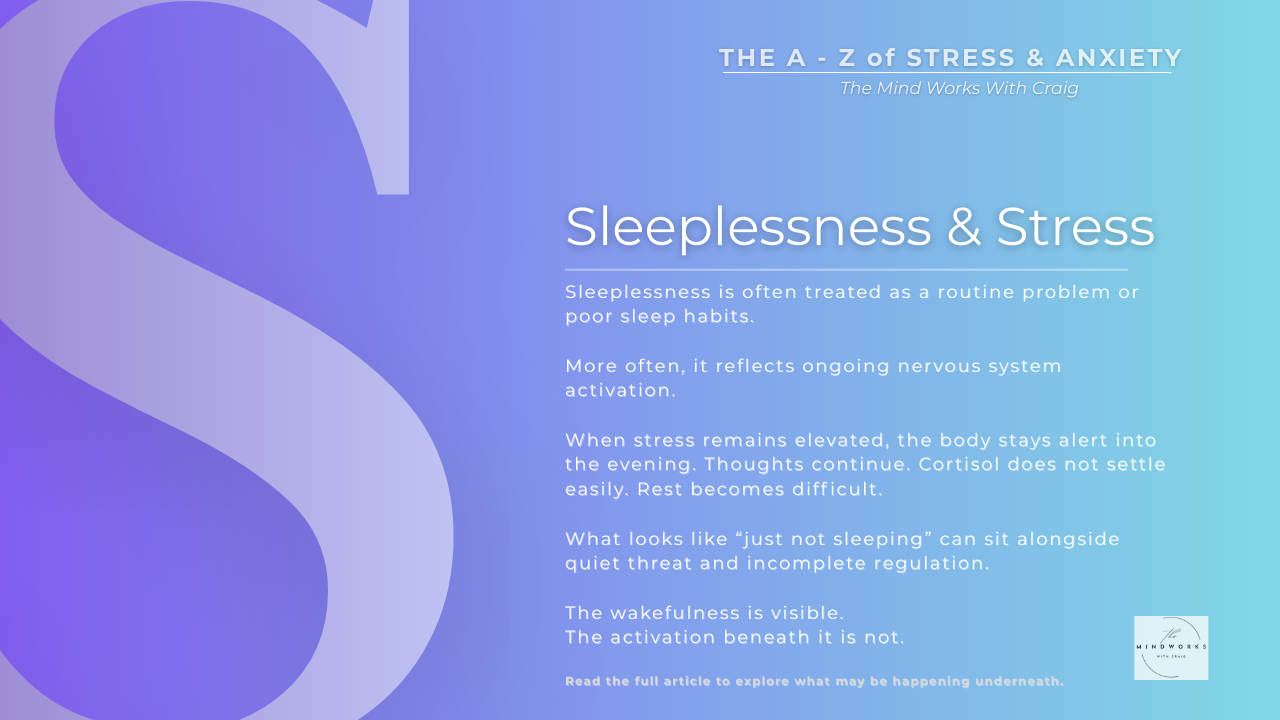
S – Sleeplessness and Stress
Introduction
This entry sits under S in The A–Z of Stress & Anxiety, a project that treats stress and anxiety not as faults to correct, but as signals from an internal system responding to load, pressure, and perceived threat.
Sleeplessness is one of the most common ways that stress makes itself known. It is often one of the first signs that the system is struggling to regulate, and one of the last areas to recover when pressure has been present for some time. For many people, disrupted sleep becomes both a warning light and a reinforcing loop, where poor rest increases stress, and stress in turn makes rest harder to access.
Rather than approaching sleep as something to be forced, fixed, or optimised, this entry explores sleeplessness as information. It reflects what the nervous system is doing, how safe or unsafe it feels, and how much load it is carrying beneath conscious awareness.
What Sleeplessness Often Looks Like in Real Life
Sleeplessness rarely presents as simply “not sleeping”. More often, it shows up in subtle, frustrating, and varied ways.
For some, it is difficulty falling asleep. The body is tired, but the mind feels alert, busy, or restless. Thoughts may loop around unfinished tasks, conversations, or decisions that feel unresolved. Others describe a sense of internal tension that makes it hard to settle, even when physically exhausted.
For others, sleep begins easily but does not last. Waking in the early hours with a sense of alertness, unease, or vague worry is common. The mind may feel unusually active at a time when it “should” be quiet. There may be a sense of being switched on rather than rested, even before the day has begun.
Some people experience light, fragmented sleep. They drift in and out, wake repeatedly, or feel as though they have been awake all night despite periods of unconsciousness. On waking, there is little sense of restoration. The body feels heavy, the mind foggy, and emotional tolerance lower than usual.
Behaviourally, sleeplessness often leads to compensatory patterns. Increased caffeine use, irregular routines, avoidance of quiet time, or over-reliance on stimulation are common. Relationally, reduced patience, withdrawal, or irritability may follow, not because of character, but because the system has less capacity to regulate.
What Is Often Misunderstood About This
One of the most persistent misunderstandings about sleep is that it is primarily a matter of habit, discipline, or technique. Advice often centres on routines, rules, or strategies, implying that if someone simply tries harder, sleep will return.
This framing misses an important point. Sleep is not a behaviour we consciously perform. It is a state that emerges when the nervous system feels sufficiently safe, resourced, and regulated. When stress is elevated, the conditions for sleep are disrupted, regardless of how much someone wants to rest.
Another common misunderstanding is treating sleeplessness as a problem in isolation. Sleep is often discussed as though it exists independently from the rest of life. In reality, it is tightly interwoven with workload, emotional processing, physiological stress, and perceived safety.
There is also a tendency to pathologise sleeplessness quickly. While sleep disorders certainly exist, many sleep difficulties arise from sustained pressure rather than underlying pathology. In these cases, sleeplessness is not the root issue. It is an expression of the system being asked to do too much, for too long, without sufficient recovery.
What Is Happening Underneath
Sleep is one of the primary ways the nervous system regulates and repairs itself. During rest, stress chemistry reduces, tissues recover, and the brain processes emotional and cognitive load from the day. When this process is disrupted, recovery is incomplete.
Under stress, the body prioritises readiness over restoration. Stress hormones such as cortisol remain elevated later into the evening. This makes sense from a survival perspective. A system that perceives threat stays alert rather than switching fully into rest mode.
Over time, this creates a feedback loop. Poor sleep reduces emotional regulation, decision-making capacity, and stress tolerance the following day. This increases perceived threat, which further activates the nervous system, making sleep more difficult the next night.
Energy availability also plays a role. Chronic stress depletes both physical and mental resources. The body may feel exhausted, but the nervous system remains activated. This mismatch can feel confusing and frustrating, particularly when someone is “tired but wired”.
Importantly, the nervous system does not distinguish well between external stressors and internal ones. Unprocessed emotions, unresolved conflict, or persistent self-pressure can all maintain activation, even in the absence of immediate external threat.
How This Fits Within the Mind Works Framework
Within the Mind Works lens, sleeplessness reflects a system that has lost rhythm rather than willpower. It often appears when multiple pillars of health are under strain simultaneously, even if that strain has developed gradually.
From a Tower Block perspective, sleep disruption commonly emerges when someone is operating below their optimal level for an extended period. The system compensates for a time, but eventually recovery processes begin to falter.
In terms of Parts of Self, sleeplessness can reflect internal tension. One part may be pushing forward, planning, or problem-solving, while another part is signalling depletion. Night-time often becomes the only quiet space where these tensions surface.
Across the Process of Change, sleeplessness frequently appears during the observing or understanding stages. It can be one of the signals that the current way of operating is unsustainable, even if this has not yet been consciously acknowledged.
Rather than being viewed as an isolated symptom, disrupted sleep becomes a meaningful indicator of overall system load.
Orientation Rather Than Solutions
When sleep is disrupted by stress, the most helpful starting point is orientation rather than intervention. This means recognising what sleeplessness is communicating rather than immediately trying to eliminate it.
Stabilisation comes before optimisation. A nervous system that feels pressured or unsafe does not respond well to effortful attempts to control sleep. Understanding the broader context of stress, energy, and emotional load creates the conditions in which rest can gradually return.
This does not mean ignoring sleep, nor does it mean resigning oneself to exhaustion. It means acknowledging that sleep improves as regulation improves, not the other way around. When the system is supported to feel safer and less overloaded, sleep often follows naturally.
Closing Reflection
Sleeplessness is rarely random. It reflects a nervous system that is working hard to manage perceived demands with limited recovery. Seen through this lens, it becomes less of a personal failing and more of a signal worth listening to.
For some, this realisation is enough to begin a shift in how they relate to rest and pressure. For others, additional support focused on stabilisation, regulation, and system-level understanding can be helpful, particularly when sleep disruption has been present for some time.
Approaches that work with the nervous system, rather than against it, tend to be more sustainable. They start by restoring a sense of safety and capacity, allowing sleep to re-emerge as part of a wider recalibration rather than something to be forced.
Anxiety, Weight Gain, or Patterns That Feel Stuck?
Understand What May Be Driving Them
Many people approach anxiety and weight loss as separate problems.
In practice, both are often influenced by nervous system load.
When stress remains elevated, blood sugar stability shifts. Cravings increase. Fat burning becomes less efficient. Sleep lightens. Focus narrows. Emotional tolerance reduces.
At the same time, internal conflict intensifies. One "part of you" seeks progress. Another "part of you" seeks relief.
Over time, this can present as anxiety, weight gain, burnout, or more complex patterns that feel resistant to willpower alone.
Understanding how your nervous system is functioning is often the first step toward steadier change.
Stay connected with news and updates!
Join our mailing list to receive the latest news and updates from our team.
Don't worry, your information will not be shared.
We hate SPAM. We will never sell your information, for any reason.