O — Overthinking and OCD: A Nervous System Perspective | The A–Z of Stress & Anxiety
Feb 18, 2026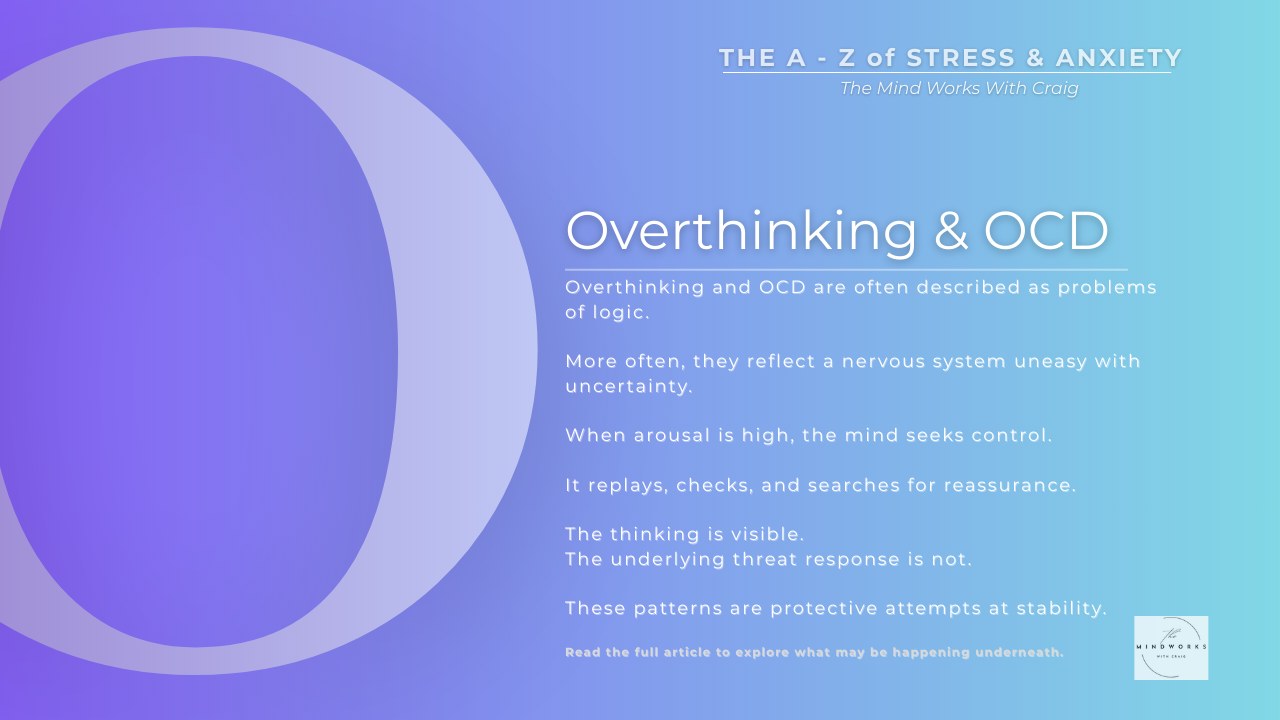
O — Overthinking and OCD
Introduction
Within The A–Z of Stress & Anxiety, each letter represents a different doorway into the same underlying system. Stress and anxiety do not always look dramatic. Sometimes they look like thinking.
The letter O brings us to overthinking and OCD. These are often treated as purely cognitive problems, as if the issue lies in faulty logic or a lack of mental discipline. Yet in clinical work, they more often reflect a nervous system struggling to feel safe. The thinking is visible. The underlying threat response is not.
Overthinking and compulsive patterns are not random. They are attempts to create certainty when the internal system feels unstable.
What Overthinking and OCD Often Looks Like in Real Life
In everyday life, overthinking rarely announces itself as such. It can look like:
-
Replaying conversations repeatedly
-
Mentally checking whether something was said “correctly”
-
Searching for the perfect decision
-
Needing reassurance but not fully believing it
-
Difficulty letting a thought settle
For some, this extends into more structured compulsive patterns. There may be repeated checking, mental rituals, silent counting, reviewing past actions, or seeking certainty about morality, relationships, health, or safety.
Emotionally, there is often tension beneath the surface. A sense of unease. A low hum of “what if”.
Physically, the body may feel tight or restless. Sleep can be affected. Concentration becomes fragmented because so much cognitive energy is being used to manage internal doubt.
Relationally, it can create friction. Repeated reassurance seeking can strain partnerships. Withdrawal can follow if the person feels misunderstood.
What is striking in many cases is that insight is present. The individual often knows the thinking is excessive. That awareness alone does not stop it.
What Is Often Misunderstood About This
Overthinking is frequently framed as over-analysis, perfectionism, or simply “thinking too much”. OCD is often reduced to neatness or visible rituals.
Both interpretations miss the deeper mechanism.
Trying to argue with the thoughts rarely resolves the cycle. Logic does not fully interrupt a stress response. Effort and willpower may temporarily suppress the behaviour, but suppression tends to increase internal pressure.
It can feel counterintuitive, but the problem is not that the person cares too much about details. It is that the nervous system is struggling with uncertainty and perceived threat.
The mind is trying to prevent something bad from happening. It is attempting control. The compulsive thinking is protective in intention, even if exhausting in practice.
What Is Happening Underneath
At a physiological level, overthinking and compulsive loops are closely linked to threat detection systems.
When the nervous system is sensitised, the brain’s error detection and prediction circuits become more active. Ambiguity feels risky. Unfinished thoughts feel dangerous.
The stress chemistry associated with heightened sympathetic arousal narrows attention. The mind locks onto potential threats and tries to solve them. Each attempt at solving provides a brief reduction in anxiety. That relief reinforces the loop.
Over time, this becomes conditioned learning. The brain pairs uncertainty with danger. It pairs checking or analysing with temporary safety. Neuroplastic processes strengthen the pathway.
The more the system seeks certainty, the less tolerant it becomes of uncertainty.
This is why reassurance often fails to provide lasting calm. The underlying arousal state remains. The body does not yet feel safe, so the mind resumes its search for control.
In this sense, overthinking is not primarily about intellect. It is about regulation.
How This Fits Within the Mind Works Framework
Within the broader Process of Change, overthinking often appears in the Recurring Cycle stage. The person notices the pattern but feels pulled back into it repeatedly.
On the Tower Block, this typically reflects mid-level instability. The system is not collapsed, but it is not fully regulated. Executive function is still present, yet strained.
Through the lens of Parts of Self, the Protective aspect is highly active. It attempts to shield the Current Self from imagined harm by scanning, analysing, and preventing mistakes. The Ideal Self may add pressure by demanding certainty or moral perfection. The internal conflict between these parts increases mental load.
From the perspective of the Psychological Processes of Distress, overthinking can be seen as a control strategy. It narrows behavioural options and consumes bandwidth, while creating the illusion of progress.
The Pillars of Health are relevant here as well. Sleep disruption, poor recovery, excessive stimulation, and chronic stress chemistry all increase cognitive looping. When physiology is unstable, the mind works harder to compensate.
Seen in this way, overthinking and OCD patterns are not isolated mental quirks. They are integrated responses within a wider system.
Orientation Rather Than Solutions
When individuals first seek help for overthinking or compulsive patterns, the instinct is often to eliminate the thoughts. To stop them. To gain control.
Yet orientation tends to come before reduction.
It is often more stabilising to understand that the mind is attempting protection. That the loops are signals of a system on high alert.
Reducing overall nervous system load, restoring sleep, regulating stress chemistry, and rebuilding a sense of internal safety usually precede meaningful cognitive change.
This can feel slower than thought suppression, but it is more sustainable. The goal is not to win an argument with the mind. It is to reduce the need for the argument.
Over time, as the system feels safer, uncertainty becomes more tolerable. The volume of checking decreases not because it has been forcibly removed, but because it is no longer required at the same intensity.
Closing Reflection
Overthinking and OCD patterns are often described as flaws of character or failures of discipline. In practice, they are far more often expressions of a vigilant nervous system attempting to maintain safety.
When approached through stabilisation rather than confrontation, the pattern begins to make sense. And what makes sense can be worked with.
Support that focuses on nervous system regulation, internal alignment, and gradual reduction of load may be appropriate for those caught in these cycles. Structured Reset-style work is not about suppressing thoughts, but about helping the system feel steady enough that the thoughts no longer need to shout.
Within The A–Z of Stress & Anxiety, O is not a label. It is an orientation point.
Anxiety, Weight Gain, or Patterns That Feel Stuck?
Understand What May Be Driving Them
Many people approach anxiety and weight loss as separate problems.
In practice, both are often influenced by nervous system load.
When stress remains elevated, blood sugar stability shifts. Cravings increase. Fat burning becomes less efficient. Sleep lightens. Focus narrows. Emotional tolerance reduces.
At the same time, internal conflict intensifies. One "part of you" seeks progress. Another "part of you" seeks relief.
Over time, this can present as anxiety, weight gain, burnout, or more complex patterns that feel resistant to willpower alone.
Understanding how your nervous system is functioning is often the first step toward steadier change.
Stay connected with news and updates!
Join our mailing list to receive the latest news and updates from our team.
Don't worry, your information will not be shared.
We hate SPAM. We will never sell your information, for any reason.