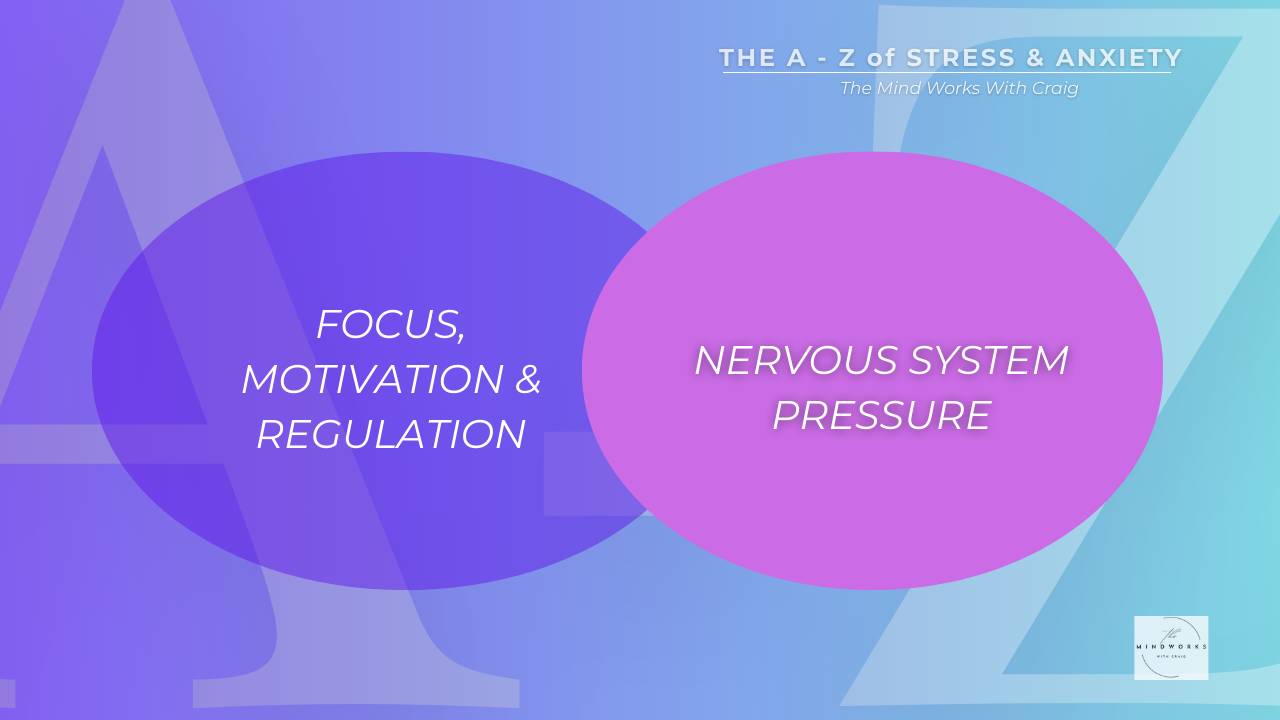
Focus, Motivation & Regulation
Understanding how stress physiology can influence focus, motivation and emotional regulation. On this page we also explore the link between stress and how ADHD may present too.
What People Often Notice
Attention and motivation are often thought of as personality traits.
In reality, they are strongly influenced by the state of the nervous system.
When the nervous system is balanced and well regulated, the brain has greater access to executive functions such as:
- planning
- organisation
- decision making
- emotional regulation
- sustained attention
These functions rely on areas of the brain responsible for working memory, impulse control and goal directed behaviour.
When pressure rises and remains elevated, access to these functions can narrow.
People may still understand what they want to do.
However, the ability to begin tasks, stay organised, or maintain focus may become less reliable.
This often leads to frustration and self criticism.
In therapeutic practice, these patterns are sometimes mistaken for laziness or lack of discipline.
In reality, they often reflect reduced regulatory capacity rather than lack of effort.
Some people also begin exploring explanations such as ADHD, particularly when attention, motivation and organisation have felt difficult for a long time.
An ADHD framework can provide valuable insight into executive function patterns that have been present since childhood.
At the same time, sustained stress and nervous system pressure can significantly influence many of the same abilities.
Understanding the role of stress physiology can therefore help many people make sense of patterns that previously felt confusing.
If you are exploring these patterns further, the guide ADHD in Adult Life provides a clear overview of how attention regulation can develop and change over time.
Why This Pattern Develops
Focus and motivation are closely connected to the nervous system’s perception of demand.
When the brain detects pressure, it initially increases alertness.
Attention narrows toward immediate priorities.
Energy is directed toward urgent tasks.
If this state continues for long periods without recovery, the nervous system gradually begins to conserve resources.
Motivation becomes less predictable.
Mental energy fluctuates more throughout the day.
Sustained concentration becomes harder to maintain.
This shift can feel confusing.
Many people know exactly what they need to do, yet struggle to begin or complete tasks.
This experience often reflects a change in available cognitive bandwidth, rather than lack of commitment.
When mental capacity narrows, ordinary responsibilities can begin to feel far more demanding.
The biological processes involved in this shift are explained in more detail in The Hidden Impact of Stress, which explores how stress chemistry influences attention, motivation and behaviour.
What Happens in the Body
Changes in focus and motivation are closely linked to several biological systems that regulate energy and attention.
Dopamine signalling
Dopamine plays an important role in motivation, reward and task initiation.
When the nervous system carries sustained pressure, dopamine signalling can become less stable, making it harder to start or sustain effort.
Cortisol and stress chemistry
Cortisol helps the body mobilise energy during periods of demand.
When this system remains activated for long periods, mental fatigue and difficulty concentrating can develop.
Working memory capacity
Executive functions rely on networks in the prefrontal cortex.
Under sustained pressure, these networks receive fewer resources, which can affect planning, organisation and attention.
Energy regulation
Fluctuations in blood sugar, sleep quality and overall physiological load can influence mental clarity and consistency.
These biological adjustments influence everyday experience.
Focus may drift more easily.
Motivation may feel inconsistent.
Simple tasks may require more effort than they once did.
Learn More
A fuller explanation of how stress influences these systems can be found in The Hidden Impact of Stress guide.
If attention and executive function patterns have been present for much longer periods, you may also find ADHD in Adult Life helpful.
How This Shows Up in Everyday Life
When nervous system pressure remains elevated, several patterns often begin to appear.
Some people notice:
- procrastination or difficulty starting tasks
- losing focus during conversations or work
- frequently switching between activities
- difficulty organising priorities
- feeling overwhelmed by decision making
- emotional frustration with their own productivity
Over time this can create a discouraging cycle.
Tasks begin to accumulate.
Motivation decreases.
Self criticism increases.
The nervous system experiences even more pressure as a result.
From a nervous system perspective, these patterns often reflect state dependent capacity rather than personal failure.
They are signals that the brain is operating with reduced flexibility and mental bandwidth.
Regulation and Recovery
When nervous system pressure begins to reduce, attention and motivation often begin to stabilise.
Mental clarity improves.
Energy becomes more consistent.
Focus becomes easier to sustain.
Emotional regulation also tends to improve, which supports decision making and follow through.
Regulation work usually involves restoring the physiological conditions that support attention and executive function.
This may include:
- improving sleep quality
- stabilising nutrition and blood sugar
- reducing ongoing physiological stress
- supporting nervous system regulation
These changes gradually rebuild mental bandwidth.
Many of the mechanisms involved in this process are explored further in The Hidden Impact of Stress, which explains how stress influences focus, motivation and behaviour.
If you are exploring long standing attention patterns, ADHD in Adult Life may also provide helpful insight.
Moving Forward
Improving focus and motivation rarely happens through discipline alone.
It usually begins with understanding how much pressure the nervous system has been carrying and how this pressure has influenced attention, energy and emotional regulation.
Once these patterns become clearer, it becomes easier to begin restoring stability.
Many people begin this process with an ADHD Support Session.
During the session we explore the patterns currently affecting your nervous system and introduce practical techniques that support regulation and mental clarity.
This may include guided relaxation, breathwork, hypnosis and strategies that help reduce ongoing nervous system pressure.
Learning More
If these patterns feel familiar, you may find the following resources helpful:
- the Nervous System Pressure page, which explains the core model
- The Hidden Impact of Stress, which explores how stress influences focus, mood and behaviour
- ADHD in Adult Life, which explains how executive function patterns can develop over time
If you would like personalised support, you can also book a Support Session to begin restoring stability in your nervous system.
Many people find that when nervous system pressure begins to reduce, focus, motivation and clarity begin to return naturally.
The Nervous System Pressure Gauge
Nervous system pressure usually develops gradually.
It tends to move through recognisable stages.
These stages can be illustrated using a simple Pressure Gauge model.
Complete Rest
Simple Activation
Strong Activation
Initial Distress
Anxious
Shutdown
At the lower end of the gauge the system is settled and flexible.
Energy is available.
Focus is clearer.
Emotional responses are easier to regulate.
As pressure rises through the middle stages, the system becomes more activated.
Attention may become narrower.
Emotions may become stronger.
Behaviour may become more reactive.
When pressure remains elevated for longer periods, the system may move further toward distress and eventual shutdown.
At this end of the gauge people often experience:
- ongoing fatigue
- brain fog or cloudy thinking
- difficulty organising thoughts
- physical heaviness or aching
- everyday tasks requiring more effort
Some people describe it as though the colour has drained from life.
Others describe it as though gravity has been turned up.
As pressure rises through these stages, flexibility reduces and conscious capacity and control narrow.
Understanding where your system currently sits can make many reactions easier to interpret.
Learn More
If these patterns feel familiar, you may find The Hidden Impact of Stress helpful. It explains how stress influences mood, focus, energy and behaviour in everyday life.
How Pressure Begins to Influence Behaviour
As nervous system pressure rises and conscious capacity narrows, behaviour often begins to change.
Tasks that once felt straightforward may become harder to start.
Plans that seemed clear may become difficult to follow through.
People often notice patterns such as:
- procrastination increasing
- emotional reactions becoming stronger
- alcohol becoming more appealing
- comfort eating increasing
- exercise feeling harder to initiate
- withdrawing socially
These changes are often the nervous system’s way of managing pressure and preserving energy.
Over time, these patterns can begin to cluster in particular areas of life.
For some people the pressure expresses itself mainly through anxiety.
For others it appears through focus and motivation difficulties.
Some experience ongoing fatigue and burnout.
Others notice changes in eating, drinking or weight.
These are different expressions of the same underlying process.
How Pressure Shows Up in Everyday Life
Although nervous system pressure follows similar patterns in the body, it can appear in different ways in everyday life.
People often notice that one area becomes more prominent than others.
For some, pressure mainly shows up through anxiety or constant mental tension.
For others it appears through difficulty focusing, starting tasks or maintaining motivation.
Some experience ongoing fatigue and burnout.
Others notice changes in eating patterns, alcohol use or weight.
These patterns represent different ways the nervous system responds when pressure remains elevated.
To explore these experiences more clearly, the site is organised into four common pathways.
Stress & Anxiety
Focus, Motivation and Regulation (you are currently here)
Burnout & Fatigue
Weight, Food & Drink
Many people recognise themselves in more than one pathway.
These areas frequently overlap because they share the same underlying mechanism.
Understanding how pressure is currently showing up in your life can make the next steps much clearer.
Learn More
If you would like a deeper explanation of these patterns, The Hidden Impact of Stress explores how nervous system pressure influences mood, focus, energy and behaviour.
Restoring Balance in the Nervous System
If nervous system pressure develops gradually, recovery usually follows a similar process.
The aim is to help the nervous system reduce pressure and restore access to conscious capacity and control.
This often involves working with several areas at the same time.
Understanding how stress is influencing thoughts and behaviour.
Supporting recovery through sleep, movement, breathing and nutrition.
Developing practical tools that help the nervous system regain flexibility.
As pressure begins to reduce, capacity gradually returns.
Energy becomes more stable.
Focus improves.
Emotional reactions soften.
Behaviour becomes easier to guide deliberately again.
Because these systems are interconnected, even small improvements can influence several areas of life at the same time.
Learn Practical Regulation Tools
If you would like to begin working with these ideas straight away, the Core Tools Course introduces simple practices that help the nervous system settle and restore stability.
This includes:
- simple awareness tools that improve emotional regulation
- practical techniques that help restore focus and clarity
- breathing practices that calm the nervous system
These tools provide a structured starting point for reducing nervous system pressure in everyday life.
Work With Me
If you would like structured support with nervous system regulation, you can book a 90-minute Reset Session.
These sessions focus on understanding your current pressure patterns and helping the nervous system restore stability.
The work may include:
- identifying the main sources of load on the system
- practical regulation tools such as breathwork and hypnosis
- creating a clear strategy for restoring balance
Even More Ways to Work With Me
There’s no single right way to begin. Some people want immediate relief. Others want deeper personal work. Some prefer to learn at their own pace.
The options below are designed to meet you where you are now not where you think you should be.
If you’re unsure which path is right for you, starting with a Reset Session is usually the simplest option.

🔄 Reset Sessions
If you feel stuck, overwhelmed, or at a crossroads, a Reset Session offers a focused pause and a way forward.
In 90 minutes, we work to settle your system, make sense of what’s happening, and create a clear, practical next step.
This is often the best place to start if things feel urgent or tangled.

🧩 1:1 Hypnotherapy
For deeper, ongoing therapeutic work.
These sessions help you explore patterns, beliefs and emotional responses, using hypnotherapy and psychological tools to support lasting change.
This is a good fit if you want space to work through things gradually and properly.

📚 Core Concepts
Explore the Core Concepts that sit at the heart of the Process of Change.
These courses help you understand how patterns form, why you get stuck, and what supports lasting change.
This is a good place to start if you want clarity and structure, with the flexibility to work at your own pace.