Men’s Mental Health Event | Nervous System & Burnout Talk | Brightlingsea Winterfest 2026
Feb 26, 2026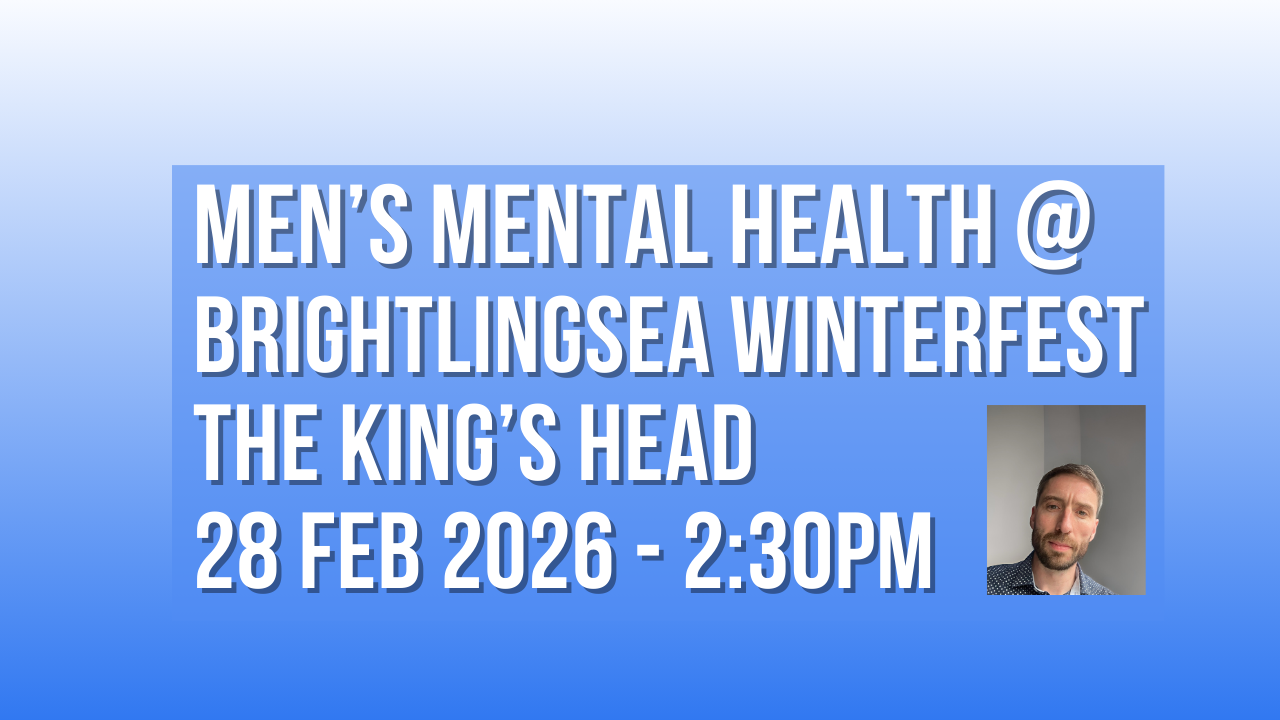
This Saturday: A Different Conversation About Men’s Mental Health
This Saturday I’ll be speaking at the Men’s Mental Health Awareness Day.
I will be talking for about 45 mins from 2:30pm at
The King's Head
41 Victoria Place
Brightlingsea
Colchester
CO7 0HT
I won’t be talking about “opening up more”.
I won’t be encouraging men to share their feelings more freely.
And I won’t be suggesting that the solution is to simply push harder or think more positively.
Instead, I’ll be asking a different question:
What is actually happening in the brain and nervous system when men struggle?
Because in my experience, most men aren’t mentally ill in the way we often imply.
They’re overloaded.
They’re exhausted.
And they’re misinterpreting what their own nervous system is trying to communicate.
The rest of this piece is a preview of that conversation.
Is There a Men’s Mental Health Crisis? Or Are We Asking the Wrong Question?
We’re told there is a men’s mental health crisis.
We’re told men need to talk more.
Be more emotional.
Open up.
Seek help.
But what if the real question isn’t:
“What should men do?”
What if the better question is:
“What is actually happening in the first place?”
What Is the Brain Designed to Do?
Is the brain designed to make us happy?
Or is it designed to predict what might happen next and prepare us for it?
If the brain’s job is prediction…
And if those predictions are shaped by past experience and current stress load…
What happens when load rises?
Does the brain become calmer?
Or more threat-sensitive?
If your nervous system is carrying more stress than it can comfortably regulate, would you expect:
-
Better sleep?
-
Clearer focus?
-
Greater patience?
-
More motivation?
Or the opposite?
Is Stress Emotional? Or Is It Physiological?
When we say someone is “stressed”, what do we actually mean?
Are we talking about feelings?
Or are we talking about physiology?
Cortisol.
Autonomic nervous system activation.
Reduced recovery.
Lower heart rate variability.
Disrupted sleep.
If stress is physiological, can you think your way out of it?
Or do you first need to stabilise the system?
In the A–Z of Stress & Anxiety project, anxiety isn’t framed as weakness. It’s framed as a nervous system state. Burnout isn’t laziness. It’s depletion.
If that’s true… what does that change?
Are We Confusing Overload With Identity?
If someone feels:
-
Anxious
-
Overwhelmed
-
Tired
-
Disconnected
Is that automatically a mental health condition or a mental health disorder?
Or could it be burnout?
If someone’s focus fragments…
If motivation drops…
If procrastination increases…
Is that always ADHD?
Or could chronic stress mimic those traits?
What happens when we diagnose before we reduce load?
Do we gain clarity?
Or do we risk increasing shame?
Why Do Men Often Push Harder When Tired?
If male self-esteem often leans toward efficacy being; competence, capability, performance... What happens when performance drops?
If you feel depleted…
Is your instinct to reduce the load you are carrying?
Or to correct for it?
Push harder.
Optimise more.
Do more.
If pushing harder increases physiological stress…
What happens next?
Are We Solving the Right Problem?
If we tell men to talk more…
But their nervous system is already dysregulated…
Does that reduce threat?
Or increase it?
If we focus only on thoughts…
And ignore sleep, load, recovery, and physiology…
Are we treating the mechanism?
Or the surface?
If we misidentify overload as weakness, even if that happens subtly…
What does that do to shame?
And what does shame do to isolation?
What If Most Men Aren’t Broken?
What if they’re overloaded?
What if what we’re calling a crisis is often a misinterpreted stress response?
What if the first step isn’t emotional disclosure…
But nervous system recalibration?
What if instead of asking:
“What’s wrong with me?”
We asked:
“What is my nervous system responding to?”
What Have I Learned?
After years of trying to understand my own mental health state; including questioning whether I might be neurodivergent - I’ve come back to one core idea:
The brain predicts based on stress load and perceived pressure
Stress is physiological, not emotional.
And pushing harder when overloaded makes it worse.
Everything else sits on top of that.
So What Actually Helps?
Before labels.
Before productivity plans.
Before motivation culture.
We reduce load.
We stabilise physiology.
We observe internal dialogue.
We recognise that different “versions” of us operate at different stress levels.
And we remember something simple:
I am a human being, just like everyone else, and I am making it up as I go.
If that reduces pressure, it’s already working.
If This Feels Familiar
If you recognise yourself in these questions; anxious, exhausted, pushing harder, questioning diagnosis - you might not be "mentally ill" in the way that it is classically defined or understood.
You may be overloaded.
If you want to examine that properly, a Reset Session is designed to look at load, physiology, self-concept, and regulation in a structured way.
Or you can explore more through the A–Z of Stress & Anxiety series, where each common “symptom” is reframed as a nervous system state.
Your system makes sense.
The question is whether we are interpreting it correctly.
Anxiety, Weight Gain, or Patterns That Feel Stuck?
Understand What May Be Driving Them
Many people approach anxiety and weight loss as separate problems.
In practice, both are often influenced by nervous system load.
When stress remains elevated, blood sugar stability shifts. Cravings increase. Fat burning becomes less efficient. Sleep lightens. Focus narrows. Emotional tolerance reduces.
At the same time, internal conflict intensifies. One "part of you" seeks progress. Another "part of you" seeks relief.
Over time, this can present as anxiety, weight gain, burnout, or more complex patterns that feel resistant to willpower alone.
Understanding how your nervous system is functioning is often the first step toward steadier change.
Stay connected with news and updates!
Join our mailing list to receive the latest news and updates from our team.
Don't worry, your information will not be shared.
We hate SPAM. We will never sell your information, for any reason.